
You learned sir, who enter among books,
Greeting at the Amsterdam Library
don’t slam the door with your tumultuous hand;
nor let your rowdy foot create a bang,
a nuisance to the Muse. Then, if you see someone
seated within, greet him by bowing,
and with a silent nod: nor waffle gossip:
here it’s the dead who speak to them who work.

November was a good month for letters; for a two-week stretch, I wrote a letter a day, sometimes two or three a day during the weekend. It was also a good month for receiving letters – often, around noon, I would hear the pounding of little feet coming closer to my door, then the rustle of paper being slid along carpet, then a quiet knock, or perhaps feet running away. If I was not on a call, I would run to the door and try to open it while Daniel was still there, then scoop him up in my arms as he squealed and shouted “NO NO NO NO NO NO NO NO NO” and giggled; then I would put him down and he would run away laughing and I would pick up an envelope from Los Angeles, or Las Vegas, or Tamil Nadu, or Paris, or Twickenham. I am unsentimental about envelopes; I tear them open and digest the contents immediately. For some, particularly Bianca’s letters, I read with a pen, marking passages that require a reaction, along with a word that will inspire my response, or just something to comment on or acknowledge. Then, they are prioritized in a pile for responses.
And other reading. My weekend books started off with Becoming a Supple Leopard; recommended by an old friend, JoJo Adams, it is both inspiring and annoying. It annoyed me because it is comprehensive and overwhelming, but it inspires me on a daily basis to adjust my position so I am aligned, my head and spine in a neutral position, which is going against decades of habit. I am sure it will be good for me, but for now, I beat myself up for slouching.
Then: How to Talk so Little Kids will Listen. If you have little kids, this is a valuable resource. It is probably valuable for life, too. “I can’t let you do that…” is something I say regularly, with almost no repercussions.
Alice asked me how many books I had finished in 2021, as she was reading a property blog, and the author said his wife had finished 77 books this year. I am currently at 53, and I do not expect that to move much through the end of the year – perhaps three or four more, at the most. I am ankle-deep in The Power Broker, recommended by David Kanzeg, and I suspect I will finish it sometime in February. It is not the sort of book to rush through; it is intensely atmospheric, evocative, descriptive, and to try to finish it quickly would be like going to a Michelin-starred restaurant and seeing how fast you could finish the courses, or doing shotskis with a £200-per-drachm whisky. I am disappointed by most biographies, but I think it says something more about me than the writers – when reading a biography of one of the founding fathers, or a robber baron, or anyone who lived more than 100 years ago, the writers have to sum up a long period of time in a relatively short number of words, because so much is unknown and unknowable. The winter of Valley Forge, for example, is often summed up by biographers in a few pages; how can the reader be expected to hear the morning bugle falter, to feel the infuriating itch of a flea bite under woollen socks inside a wet leather boot, to hear men debating quietly to determine which horse to slaughter for the next meal, to hear a scream muffled by the snow from the surgeon’s tent and then silence, and to have these scenes repeated for the whole of a winter? A biographer’s task is to take all the knowable information and convey it in a way that helps the reader understand a life – and to do it in as few words as possible. The thing is, so many biographers take all the facts and then lay them out bereft of atmosphere, without an intelligible context.
Caro, on the other hand, had the advantage of access to people who knew his subjects, and could ask them about individual conversations; he could get the context AND the information and the various perspectives involved. His challenge was – and is – understanding the full narrative and describing the forest by painting individual trees.
And he is stupendous.
The subject of the book is Robert Moses, but there are times you forget who you are reading about, because you feel like you are part of the time, the world, and nobody can go through life just looking at one thing – our lives are more complicated than that. We don’t know only about ourselves; we know all sorts of things about the world, take for granted names and countries that didn’t exist fifty years ago and may not exist fifty years hence. Who will remember John Kerry in fifty years? Valerie Plame? Donald Rumsfeld? Henry Kissinger? Elizabeth Gilbert? Condoleeza Rice? Tom Brady? They may loom large now, but their names are written in sand. And who today knows Al Smith, Sam Rayburn, Belle Moskowitz? The Teapot Dome scandal? So Caro spends extended periods ignoring Moses completely, and focusing on someone or something else, in order to put Moses in his historical context; the reader learns about the history of governmental change in New York, about robber barons on Long Island, about Al Smith and anti-Catholic prejudice in the Presidential election, Franklin Delano Roosevelt as a young politician in Albany, and then more fully understands the main character of the book. Other biographers focus on the subject, painting an individual tree; Caro paints a number of individual trees, and only later does one realize that Moses is not a tree, or even the largest tree; Caro has painted Moses as a forest.
Anyway, this is going to take me a long time, and my book number will suffer, but that’s ok. This is important.
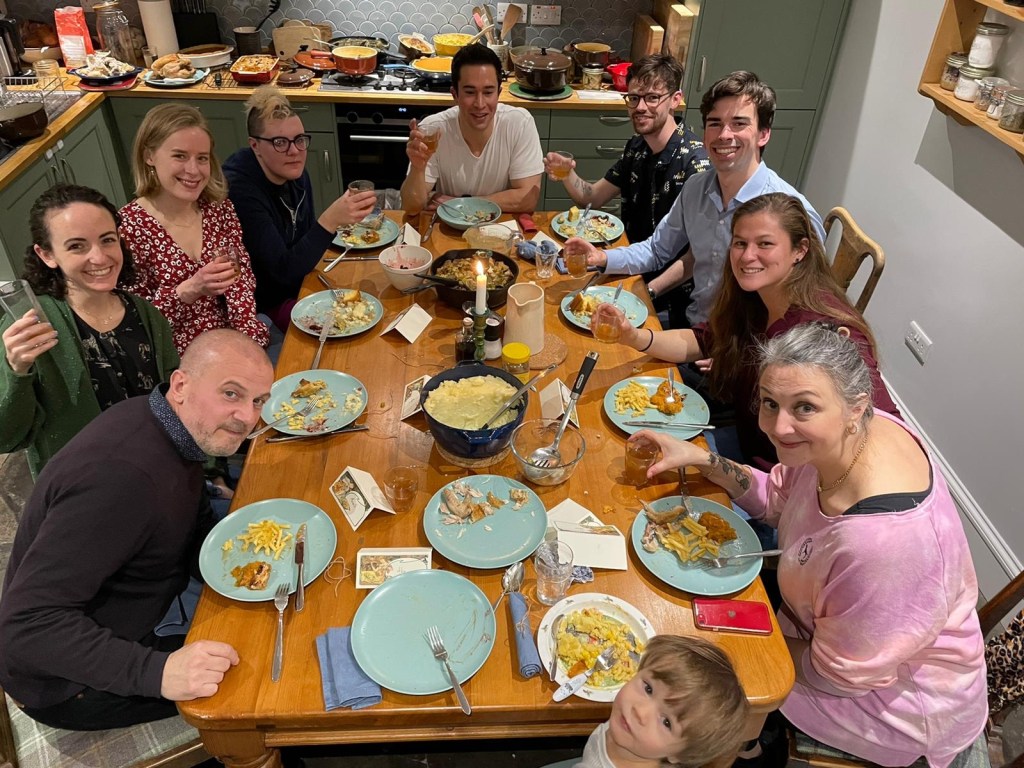
I decided that we would have a full Thanksgiving feast, and invited people. We ended up with ten adults and Daniel, crowded around our kitchen table, talking over each other in constantly evolving conversations. Kristy came over early and made pumpkin pies; I made everything else, from sourdough stuffing to bourbon nutmeg caramel sauce to a traditional punch that involved an entire bottle of Cuban rum that we finished 45 minutes into the meal. Daniel took a long nap so that he could stay up late, and he sat on his chair at the end of the table and shouted “I WANT MORE MAC AND CHEESE!” like a little emperor and I would hurry over to get more in his beautiful little mouth. It was both glorious and tragic. The old me would have had people over until two a.m. on a school night, smoking hookahs, finishing bottles, making a scene like Fitzgerald described in the hotel in the Great Gatsby; people would have looked up at our windows and wished they could have been part of our select crowd. With Daniel, I had to stop myself from hushing people in the hallway when he was going to sleep at 10.
Oh, but for Daniel, it is worth everything.
At one point this month, I was holding him; his head and knees were against my chest, and his arms were tucked in between his legs, and I was rocking him. Then, out of nowhere, he said, “I wish I were a little bit taller.” He has recently taken to telling me that he is “All growned up now”; I think it is a sign that he understands different life stages, and he thinks he is in one of them. But now, he wanted to be taller, and my immediate thought was that he is too young to feel inadequate – but then maybe this is a normal phase for him to go through, comparing himself to me and Alice and other kids he plays with and people he sees on the street, or, worse, that we are doing something wrong. I became very emotional, and hugged him closer to me to comfort him as he said it again.
Then I remembered something.
“Do you wish you were a baller?” I asked.
“Yeah.” He shifted a bit.
“Do you wish you had a girl who looked good so you could call her?”
“Yeah.”
Do you wish you had a six-four Impala?”
“What’s a six-four Impala? What is that, daddy?” he asked. He leaned back to look at me, held up his hands to indicate cluelessness, and said, “I don’t know!”
“Do you want to listen to that song?”
“Yeah.”
So we listened to I Wish, by Skee-Lo, and danced, and I was grateful to have a little more time until I had to deal with any feelings of inadequacy he might have, and that he is listening to music.
Other questions he asked this month: “What’s a trampled flag on a city street? What is that? I don’t know!”
“What is Delacroix?” For this, we got out a map of Louisiana, and looked at New Orleans and Baton Rouge and finally found Delacroix, and imagined the bayou.
He has a train that is connected by magnets, one carriage to the next. He was pulling it along, and I decided to count them: “One, two, three, four, five, six, seven, eight, nine.”
He looked at me very seriously, and said, “It’s the Ten Crack Commandments. I want to listen to that song, daddy.”
And once: “What is this song?”
“It is Los Angeles, by my friend Katie. It is one of my favorite songs.”
(Pause, then quietly) “It is one of my favorite songs, too.”
If nothing else, listen to Katie, and try not to mourn falling in, falling in, love.
Then, yesterday, he asked me to play “Paydabulls.” I kept asking him to repeat it, but he just kept saying the same word, over and over again. Then, finally, he looked at me sadly and said, “I don’t know the words.”
It broke my heart. Not only does he know that his language is ever-increasing, and that he is learning it, but also that parts of it are beyond his reach; that his skill set is not fully developed, and that in this way, his ability is inadequate for his ambitions.
And that this is our responsibility: to help him develop his skill set. But that’s hard when he doesn’t have the words, and I can’t figure out how to get him to describe what he wants.
But I thought, and then
“Do you want to listen to Bulls On Parade?”
“Yeah!!!”
So we listened to Rage Against The Machine on repeat, maybe 12 or 15 times, running around the living room and flailing our arms and jumping over LEGO towers and trains and piles of books. We both had to stop for water, and then prunes, and kept going.
And Alice and I have been having more and more conversations about community in Edinburgh recently. We went to Stirling, a smaller city, for a short break, and on each train stop along the way I wondered why we were in Edinburgh. Cities are tough for community. Couldn’t we move to a small place and meet everyone and have a more solid sense of community than we have in a city? Wouldn’t our complaints about not having enough space, and poor schools, be solved by going somewhere WITH these things? At the same time, I have started to notice that whenever I go out, I see someone I know. It might be a nod of the head and a wave; I might have to stop for a minute to talk; I might sit down on a bench and discuss a book at length with a guy from Jiu-Jitsu. But suddenly, after four years, I find that I have to anticipate that I will see someone I know when I go outside of my front door, and that I will have a chance to make a deeper connection with them.
So we do have community here, and that is exciting.
And the high point of this, so far, was going to my tailor to have some work done – a gift for my sister which, for now, I have to be coy about. He finished it in a day, and I went to pick it up; he showed me the details of what he had done, and his work was exquisite, and expensive, and worth it. I tried to pay with a credit card. He explained that the card reader was not working, so I would need to pay with cash. I was holding my stuff, and pushed it across the counter so he could hold them while I went out to get cash.
He looked at them, and at me, puzzled, and then scoffed. SCOFFED. And pushed them back.
“Come on, man,” he said. “Bring it when you have it. I trust you.”
I had one of those “I’ve made it” moments. I have personal credit at a tailor – and not just at a tailor, at my tailor, the guy who fixed my swim trunks, and jacket, and a dozen other things. He knows me and likes me and trusts me, in a city of a million where neither of us are native, to pay him what I owe him without needing security. I had flashbacks of The Sun Also Rises; this is how Mike Campbell started going bankrupt, owing money to a tailor. But at the moment, it felt like great wealth.


 Andrew Samtoy
enjoyed, as always. feels like I’m there.
LikeLike