“We live in the flicker—may it last as long as the old earth keeps rolling! But darkness was here yesterday.”
from “Heart of Darkness” by Joseph Conrad
They can invade at any time. Lives can end, or at least be upended.
When I was a senior at Pitzer, one day I had something to celebrate – I think it was when the administration backed down and we won the right of dining hall workers to unionize. I had gone to my room and taken out my grey and green Pitzer insullated plastic mug and poured a lot of Chivas Regal into it – I didn’t know about drinking, but Ben and Becky and Patrick had bought it for me, and they were European, and if they bought it then that must be what fancy people drank when they were celebrating. I went to the mounds at the center of campus, and sat on the little white brick wall in the California sunshine, and was drinking slowly when Sonny swaggered up to me. I had met him a couple years before, when I was his RA in Sanborn, but hadn’t really spent much time with him – he was a rockabilly, who walked around with a wad of chewing tobacco in his lip, a big pompadour, a lot of attitude and tons of charisma. Everyone liked or loathed him. We were talking, and he suddenly got a funny look on his face.
“Are you drinking whisky?” he asked.
I was. Did he want some?
He did, actually.
We started sitting near each other in the one class we shared: Laura Harris’s seminar on literary theory. It was the height of the Abercrombie craze, and I had been struck by the similarities between Nazi propaganda and Abercrombie photos, so I did my final project on the influence of fascist art and aethetics on modern advertising, reading Albert Speer and comparing sculptures of Aryan youth with photos of Abercrombie youth. It was so uncomfortable for people from across the political spectrum that only two people in the class approved of it: Professor Harris, who thought it was exactly the kind of edge-pushing work she wanted to see, and Sonny, who, for once, wasn’t the one offending sensible people. (I believe his project was on the literature of baseball.).
He started inviting me to parties, and I would mostly decline. I don’t know what his motivation was; I was not a partier, or part of his crowd. I have two more distinct memories of him that semester, though: in one, we were at a party at Pomona College that his fraternity was throwing, a Roman-themed bacchanal. He was leaning against a doorframe, a red cup in his hand, kissing a girl I knew named Meredith. Suddenly she fell down to the ground, passed-out drunk. He lifted the cup to his lips, took a drink, and then looked around casually at the party around him. Two other people rushed over to pick her up, and only then did he realize what had been happening, and laughed.
Another time, we were at a party in Mead. I stuck to my friends, of whom there were maybe two in the room; it wasn’t the sort of place the president of the student body would normally be, I thought. A very pretty girl came up to try to talk to me, and I was polite but still uncomfortable, when Sonny grabbed me by the shoulders and shoved me against the wall, his face inches from mine. He looked at me angrily, and growled, “You’re Andrew Fucking Samtoy, now act like it.” And patted my chest.
I still think of that when I am uncomfortable.
When I graduated, I moved to Portland, then back down to San Diego; I went to his graduation, and we exchanged phone numbers. I didn’t expect him to call, but then he did, and convinced me start working out in the mornings with him at Gold’s Gym. We would start upstairs, at the core machines, and then rotate downstairs among different racks; almost every workout ended with the Ground Base Jammer, a machine that simulates throwing a straight punch with a 90-pound glove on your hand, or picking up someone by the neck and hurling them backwards. After that, Sonny would always say, “Time for the most important set of the day,” and we would go wash our hands. When asked, he would say, “There are so many germs on those bars, man. This place is filthy. You could get AIDS here just by working out.”
Something bothered me about that, so one day, as we were walking to the restroom, I said, “Hold on a second, man. You make us wash our hands every time we work out, but you go and fuck whores in Tijuana. How do you reconcile that?”
He stopped and looked at me with pure scorn in his eyes, and then, as if I was a particularly stupid child, he said, “I wash my hands after that, too.” Then we walked to the sinks.
When 9/11 happened, he had immediately tried to sign up to be a Marine Corps officer like his father, but the officer candidate school was overwhelmed with applications and he didn’t have a prayer. After a period of time parking cars downtown, he joined the Marines as a grunt. He gave me his address in boot camp, and I wrote him letters – the whole time he was there, he was never more than a few miles from me, but it felt like a completely different world. When he graduated, I think I was one of two or three people outside of his family to show up. That weekend, we drove to Pitzer, where he ate something like six plates of food in 15 minutes in the dining hall, and we wandered around the Claremont campuses drinking as he taught us the songs that they used to keep marching cadence –
“I gave her inches four (I gave her inches four)
She said honey I want more (she said honey I want more)
Put your belly next to mine and drive it on (DRIVE IT ON!)…”
He would bring other grunts home to his father’s house on the weekends, and we would all go out drinking at The Princess and try to meet girls. At some point in the evening, they would be drunk enough that they would insist on showing me self defense moves that they had picked up that week in training, which inevitably involved a headlock, then some sort of throw, and then the bartender shouting at us to get the fuck out and see you next weekend and say hi to your old man. One Saturday, we drank a bottle of Johnnie Walker Red, slept for two hours, and then drove to a track at UCSD – I had signed up for two hours of running in a 24-hour relay, and I had the 6-8 a.m. shift. When we showed up, Jennifer Mendoza, the organizer, looked at us and sighed.
We started running. Every time I slowed down, Sonny would say, “It’s for cancer, man, we have to keep going. It’s for fucking cancer, man.” People stopped running behind us as the alcohol seeped out of our systems and we left a vapor trail. When we finished, we took showers in the locker rooms, then got dressed and went to a fundraiser at the La Jolla Beach and Tennis Club, and then went out drinking in Pacific Beach for the afternoon.
He moved to Quantico, for officer training, then went to Iraq. He got married before and after leaving – before, a legal wedding, in case he was killed, so his wife could claim benefits, and after, a big Catholic church wedding for the benefit of her family and grandmother. I was at both of them, in Chicago. At the legal wedding, I drove up on a Friday night and we spent the night drinking, a big group of their close friends, and that Saturday, we all went to the courthouse early. Sonny was dressed in civilian clothes, but had forgotten some piece of clothing – garters? – that connect the top of one’s socks to the bottom of one’s shirt; the idea was to keep the socks up above the ankle and the shirt tails pulled down tight. He was complaining about the fact that his socks wouldn’t stay up with two of the other men in the group, who were Marine Corps officers and knew how annoying it was to not have standard issue accessories. Suddenly a grunt walked in wearing his uniform – the kid must have been 18 – and a girl who must have been his fiance, all eager to get married. The three officers all immediately noticed that he was in uniform but didn’t have a belt.
“We have to say something.”
“Don’t be a dick you guys,” Sonny’s fiance said.
“We have to fucking say something. There are standards here that must be fucking adhered to.”
“Sonny, the kid is having the best day of his life. Don’t ruin it.”
“I bet his socks are up real high on his legs,” I said.
They all looked at me.
“But someone has to say something to him,” Sonny said.
“No, Sonny, you can just let him have a good day.”
“His shirt is perfect, all tightly tucked in…”
I think Bart was the one who handled the situation diplomatically, congratulating the kid and then letting him know what they saw. Maybe he slipped the kid some money, I don’t know.
At the next wedding, the big church one, Sonny’s best man, his brother, was too drunk from the night before to give the speech, so I had to make one up during the ceremony, scribbling notes on the program. I gave it, and I think it was good, and that was the height, maybe, of our friendship. I saw him a handful of times after that – when he was in Cleveland, or I was in Chicago – but things changed. He had kids, and started law school, got a job, and then I eloped, and he got divorced, and he responded rarely to my emails, maybe with a line or two. I think the last one he responded to was about me making a choice to live in Edinburgh over Glasgow; Edinburgh, he wrote, was “less stabby.” Sometimes, I mention that to Glaswegians that I meet, and several have paused and then said, “That’s probably the single best way I have ever heard to explain the difference between the two.” I don’t know how he knew it so well.
Sonny was someone I loved in my life – the closest I had to a real male best friend in my life, probably. Is that true? Maybe. But his friendship was certainly one of the truly defining, shaping forces in my life. It scares the hell out of me to think that that didn’t exist outside of my mind before I wrote it down, and that if the Russians killed me, it would have disappeared from the world, these memories I love so much of people I love so much, like
2. Tom, around the same time.
I was driving back from Portland to San Diego in defeat – I hadn’t been able to hack the rigors of a political campaign, or a new city far from my home and girlfriend. I drove South from Portland in January or February, as quickly as I could, entering California and pushing on. I got to San Francisco and Shawn was there; he was working for some friend-of-a-father-of-a-friend, and living on the friend’s couch, and it sounded startupy and interesting and I could stay for the night on their couch before moving on. I followed the Mapquest directions and parked and was next to a park, full of people, not the cold of Portland but the warm, hazy afternoon of the bay; I can still hear golden retrievers barking and see frisbees entering orbit. I called and met Shawn and he brought me to the apartment. I was expecting cheap carpet, a dirty sofa, aluminum cookware, but was greeted by the calmest, most peaceful and beautiful and comfortable living space I had ever been in. I was instantly jealous that Shawn got to live there for free, even if he was just sleeping on the couch.
We hung out for a bit and then the door opened and I heard this resonant voice saying “Hello-o?!” and Tom walked in. I can still remember his face turning the corner and it makes me smile. We all went out to dinner, and I remember nothing of the evening other than that I called my girlfriend from the road and told her I met the most wonderful man I had ever met, and when I got to San Diego, as soon as I could, I wrote him a letter, and signed it, “Love, Andrew.” I think he wrote me back to say he felt the same.
I just realized: that was almost exactly twenty years ago.
He invited me to stay with him in San Luis Obispo – by this time, Shawn had gone down to Los Angeles, and I never actually saw him again – and I was suddenly writing to him regularly. He helped me choose between a JD/MBA and a JD; he told me that the people he knew who got JD/MBAs didn’t get a full JD or MBA, so he recommended one or the other. When venture capitalists started trying to invest in Cash Mobs, he helped me with references and recommendations; I flew out for his 75th birthday party, and only just now, while writing this, realized that he is over 80 now, and I can’t believe it. It was one of the most incredible parties I have ever been to – he rented out a restaurant, and there was a huge range of people there, and I realized that all of us loved him, and I was so inspired by that.
And in thinking about what I know about Tom, I am not sure how much is truth and how much is legend. In a way, he is a lot like my paternal grandfather, who I never knew and who exists in my mind only as a series of stories, some of which are contradicted by other stories that are told with just as much certainty as others, except that with Tom, many of them are first-hand. Things I learned about Tom over the years:
- He once started a magazine in Portland, Oregon. He was looking for investors, and sent a business plan to one, who looked it over in Tom’s presence. “These margins are really good,” the investor said. “Yes,” said Tom. “Wow. These margins are REALLY good.” “Yes, said Tom, more and more confused. Only later did he learn what business margins were, and that the investor was not talking about the 1.5 inches that Tom had left at the edge of each page.
- He lost an eye when he was very little. Later in life, he worked for a US Senator who had also lost an eye. The Senator ran for the Democratic nomination for President in a year when the Democrat was likely to get trounced – maybe 1984? But everyone besides the Senator and Tom thought that he could very possibly win. He didn’t get the nomination, though, and at his concession, he walked up to Tom, embraced him, and whispered in his ear, “In the land of the blind…”
- Tom reads voraciously, but doesn’t keep books. Instead, he gives them away when he is done, which is something I really should learn to do.
- Something about his watch struck me as odd once, but I couldn’t quite put my finger on it. Years later, I realized what it was: his watch didn’t have a second hand. When I asked him about it, he said the second hand was “surplus to my requirements,” which is still one of the most executive things I have ever heard.
- He once bought land in Sonoma. The town it was in didn’t have a post office, so Tom negotiated with the government and built a post office, then gave the government a 100-year lease on it. The lease pays for him to have a winery and an apartment as well. This from the guy who didn’t know what margins were.
- Oh – and he was also the PG&E exec who settled with Erin Brokovich. IRL.
When Alice and Daniel and I visited California, just before Covid, he flew down from San Francisco to Los Angeles to get lunch with us – just lunch, and to meet Daniel. Then he flew back. It felt like the most luxurious thing in the world, and such a huge honor.
And as I watch Ukrainians sleeping in bomb shelters, clutching their cats on trains, or training with fake rifles that might turn real at any moment, I keep thinking that everyone has these people in their lives – the defining personalities that help us move forward and grow. And the world will spin and may soon end and the record books won’t have anything about them. I don’t know anything about who these people may have been from my own parents – my mom keeps saying that one day she will tell me, or write me; my dad just doesn’t ever seem to think memories are important. But to me, they are what life is – memories, connections that we make.
If the world ends, or if I end unexpectedly, I want to make sure that if Daniel remains, he knows some of these things about me. If I don’t survive long enough to tell him myself, maybe one day he can read these things and feel like he knows something about the people who have made me what I am.
And if that man in the east is remembered at all, let it be with revulsion by those outside of Russia, and shame by those within.
“I don’t like work. I had rather laze about and think of all the fine things that can be done. I don’t like work—no man does—but I like what is in the work,—the chance to find yourself.”
– “Heart of Darkness” by Joseph Conrad
Books in February:
- A Moveable Feast – I scheduled this for January, because for some reason the cold of Paris in the winter and the warm St James rhums and the burning of twigs in a heater to warm up an attic are the senses that stick with me, but really, this is as much about spring as winter, and maybe I should have read A Farewell to Arms. I read the restored “original” version; like The Road, it felt like the whole book was a complete setup for one final, stunning, perfect last page, and it makes me really sympathize with the lead character in Midnight in Paris.
- Speak like Churchill, Stand like Lincoln – I read a chapter a day of this a day; then I applied some of it in a talk I gave about Triumphs of Experience. It is solid public speaking advice for people who already have some experience, but want some nuances on structuring a speech that may not come from Toastmasters or Dale Carnegie.
- Triumphs of Experience – I always think of David Rossi when I read this. He was my landlord when I first got to Cleveland, and I once suggested he might like it, and he got it from the library and now reads it regularly. I read it this year for a reminder of what is important in growing up, and life, and then got the chance to give a talk on it.
- Heart of Darkness – A while ago, I was speeding through the first few pages and hated it. Then I came to a line – I can’t exactly remember what it was, perhaps that darkness was here yesterday – and realized that I was probably missing something by trying to finish reading it, rather than reading it slowly. So I went back to the first page and slowed down, and got lost almost immediately – this was when we were living in London and I crossed the Thames every day, and suddenly the river, the whole city, really started to mean something to me. It wasn’t just a place to live, work, and play; it was a crossroads, a destination, a launching point, the site of and originator of some of the worst barbarity in history. I understand Achebe’s objections to it, but I also think it is a clever condemnation of colonialism.
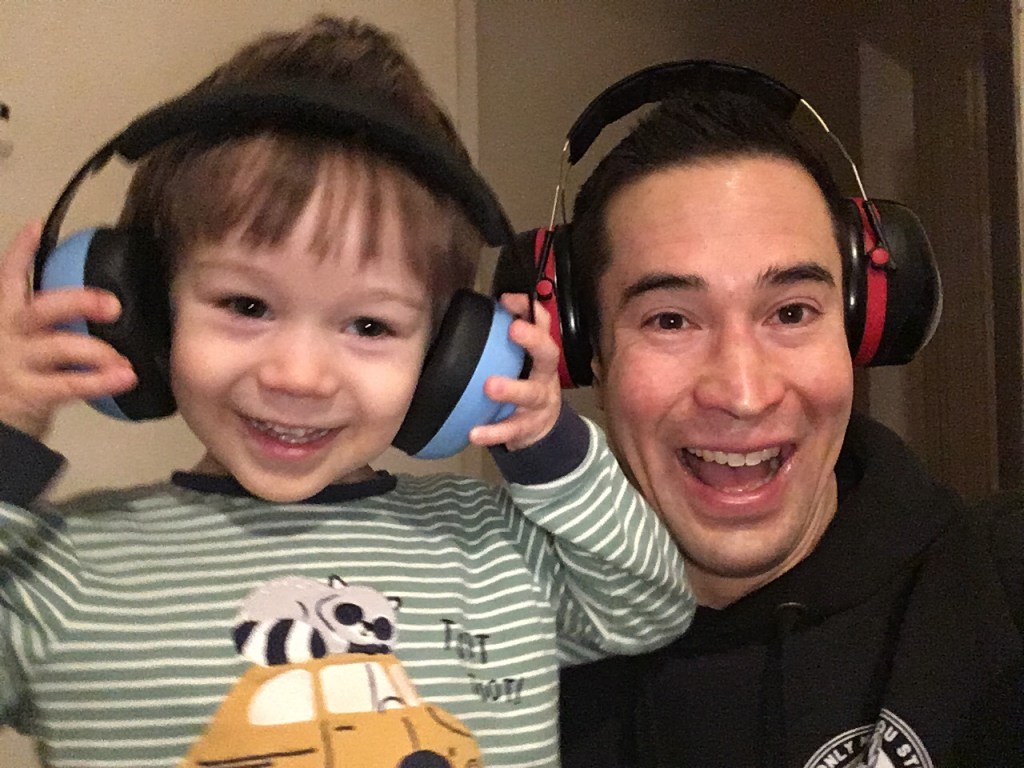


Daniel’s imagination is exploding. He makes things up, and has a memory like a steel trap. He is into The Ramones, and Fugazi, and Jerry Lee Lewis. I accidentally told him that Lewis was dead, but then learned he is still alive, so now every time Great Balls of Fire comes on, Daniel asks me if he died in a terrible plane crash, and I tell him no, he didn’t, and that I confused him with Buddy Holly. It didn’t occur to me until today that death may not be something to talk to a two-year-old about; some parents came over for a play date, and their cat just died, and they told their own two-year-old that it was just visiting someone else for a while. “Why can’t they tell the kid the truth?” I asked myself, silently. But parenthood is a minefield; I am sure that one day Daniel will have plenty to tell his therapist about me.
But he will never be able to say I didn’t love him.
And so many other people in my life.
 Andrew Samtoy
I had fun following all your travels around the States and reading about your past life.
Have you thought about publishing any of thi?
LikeLiked by 1 person
Touching ending about Daniel – and beautiful photos of him. xoxo
LikeLiked by 1 person
Thanks Mrs. B!!!
LikeLike
Paul – thank you, I had no idea you read it! I’ll never say never…but I am content if my friends can read them and, like Tom, correct me where I am mistaken (it was his 70th birthday, not 75th!) and maybe remember something themselves. If my kids read them, and know more about me, that is the ideal. Sending love!!!
LikeLike