A Rage Against the Machine song came on Spotify, and I had never heard it before.
“Alexa, what is this song?”
She told us that it was…some song, from their album The Battle of Los Angeles.
“Daddy, what is Los Angeles?”
“It is a city in California. It means, ‘The Angels.'”
“What is an angel?”
I thought.
“So…there is this story about someone named God. In the story, he can see everything and knows everything and can do anything.”
“Is he a man?”
“Well…yes and no. Also, in the story, he lives in the sky.” I began thinking of my friend Wendy.
“Is he a bird?”
“Well…yes and no. He is supposed to be in everything.”
(Pointing) “Is that bird God?”
“So…yes and no. It’s complicated. But he has helpers called Angels, and THEY have bird wings.”
Then he said, “I want to listen to Rage Against the Machine,” which was convenient.
For the next two weeks, he would occasionally ask, “Who lives in the sky?” Then, Easter came around, and I decided to be proactive about it.
“So remember God? He has a son named Jesus, who is also a man, but not a man. There is a story about him dying, but then he comes back to life, and on Easter, everyone celebrates the fact that he came back to life by pretending a rabbit brings them eggs, but sometimes the eggs are chocolate, or candy, and sometimes they are real eggs, but hard-boiled and painted.” Again, I thought of Wendy, and Zeezee, and wondered how I had lived for 42 years thinking that it made sense to present these things as some sort of rational, logical truth that children should believe because it is, in some belief systems, harmless.
How do people justify telling them about the Tooth Fairy?

In early March, our neighbors, Cathy and Marcello, came over for coffee and cake. We were talking about books – something that we might talk about with two authors. Cathy’s latest book was about to come out, and somehow we got on the subject of Alice Sebold and her memoir, and the exoneration of the man who was convicted of raping her. We started talking about the characterization of books, and how memoirs are generally classified as non-fiction, or believed to be mostly non-fiction, similar to autobiographies. As opposed to autobiographies, though, they aren’t an account of a full life, but of a section or sections of a life. The very definition of a memoir is, “a historical account or biography written from personal knowledge.” But that is a very strange way to think of a memoir, because the word comes from the French for “memory,” and memories are flawed – in the case of Sebold, with sometimes disastrous consequences. In her case, is an apology enough? Or did she need to apologise in the first place? Should we take all memoirs as something between fiction and non-fiction, with a bias towards thinking that they are partially true? When an author says something bad about someone, like accusing them of a crime that they didn’t commit, should they be liable for libel? What if the justice system establishes guilt as a legal fact, but is wrong?
Memories.
I think this happened in March, 1999; it was the Friday before Spring Break, in a bright Los Angeles morning, when we could see the foothills without smog. It was a halcyon time when anyone on campus could email the entire student body simply by writing to students@pitzer.edu. I had sent out a message a few days before that I was going to San Francisco for Spring Break, and if anyone wanted a ride, I could provide one. Three people responded: my former roommate, David, who was a half-Korean hippie from Orange County; a cheerleader-type Scripps student who wanted to visit friends, and who seemed bubbly and non-offensive; and someone from Pitzer named Bianca. We all met, put our bags in the trunk, and got in.
I don’t know how Bianca ended up in the passenger seat – David was at least a foot taller than either of the women, and he might have had a claim on the leg room. But she was to my right, and David and Scripps were in the back, and I started the car in the Sanborn parking lot and we headed up the state.
The first moment – the only moment – I remember from that trip happened soon after we got on the road. Bianca was looking out the window, and said, “I never thought I would spend New Years naked, tied to a pole, getting whipped by transvestites in a basement in Oakland.” I looked at her, and she was just sitting there, looking out the window. I said, “We are going to be friends.” The rest of the drive was just us talking; I don’t remember interacting with the others at all, besides rest stops in the central valley. Otherwise, Bianca and I talked for seven or eight hours. When we got to the bay area, they all went their separate ways, and I knew I would see her again – the campus was only about 800 students, so we were bound to run into each other. We hugged.
Except maybe that didn’t happen. According to Bianca, there are two problems with this story: first, we HAD met. It was months earlier; she was in the dining hall, meeting with Laura Harris, an amazing and intimidatingly brilliant literature professor whom Bianca really wanted to impress. She had gotten dressed up and put makeup on, and they were getting juice at the juice machines, and I walked over to her, looked down, and declared, loudly, “Those socks are bougie.” Then I walked away.
“Who the fuck was that?” Professor Harris asked.
Bianca, shocked, said she had no idea. I can only assume that they bonded over it. I knew how to bring people together back then.
Second, there are details of what I remember her saying that are inaccurate – I can’t remember, but I think it wasn’t New Years but maybe Halloween, or the basement was in Berkeley, not Oakland; this level of specificity makes me question my memory, of course, but also reinforces that it did happen – that she said something that was roughly as shocking and impressive, and that I was struck by her openness and candor. I could ask for clarification, but this is memoir, and it is suspect. Memories are suspect. At some point, I met Bianca.
The rest of the semester was rough for me. I had been dumped by my first real girlfriend on Saint Patrick’s Day, maybe a week before the trip, and was depressed. Bianca would come by my room and we would listen to Malcolm X speeches and Tupac and Wyclef Jean singing “Gone Till November.” Nobody had cell phones, and I remember hearing a voice shouting to me over the music, looking down through the trees outside my window, and seeing her standing in the grass, a huge smile beaming up. She would come to tea parties I threw and make fun of my rebound, Adele, who Bianca called a “flat-bootied ho,” which became her term for every girlfriend I ever introduced her to. It was the beginning of a dynamic: Bianca would meet someone I was seeing, they would hate each other, but the girl I was seeing would have to pretend to like Bianca because I loved her and wouldn’t consider losing her as a friend. Bianca was never that diplomatic – she didn’t have to be, because she was in a more secure position.
On weekends, we went for Thai food, or to In-N-Out, or Trader Joe’s, because she didn’t have a car, and I was glad to be in her company. We went to one party where she was part of a lesbian orgy in an elevator, which I didn’t know about until after the fact; I was sitting there at the party making awkward conversation with people I didn’t know who were drinking. Her exploits were so far from anything I had ever thought of or experienced, and I found her fascinating.
Yet our friendship was, and always has been, entirely platonic. That’s the weird thing – we are more like family, where she infuriates me, and I infuriate her, and we sign everything “Love”.
A few months later, I went to study abroad, in Wales. We emailed, and wrote letters, and when I visited Pitzer just before Winter Break, we had tea and she introduced me to her Japanese friends and her boyfriend, who had long red hair, was very pale, and who drove a hearse and had a coffin as a coffee table. His roommate was a Saudi exchange student; I can only imagine what he thought of American culture.
In Spring, I decided to run for President of the Student Senate from abroad – an uphill task, seeing as 1/4 of the student body had no idea who I was, and 1/4 was leaving. Bianca was more or less a campaign manager for me – fliering, going table-to-table during meals to ask people to vote for me, letting me know the situation on the ground. At one point, she decided to spice up the campaign, so she created a flier with my head pasted on a gay male porn star’s body, with the story of how the student senate had once passed a joke bill requiring me to streak across campus with the other Student Senate officers, and I did, and she created a huge tagline: “Andrew Samtoy, Naked for Pitzer.” The story was entirely true. I won by something like seven votes, and credit her with them all, and more.
I came back to Pitzer, and Bianca immediately went to study in Japan for a year; it’s crazy to me to think we only really hung out consistently for maybe two months. Then, I graduated and she came back to Pitzer, except I started dating a woman who was still at Scripps, so I came to visit on the weekends. Bianca was always there – we would meet for a meal or coffee or a walk, usually alone. Then, one weekend, it was Bianca’s birthday. I called her to see what she was doing for it, and she told me that her boyfriend was going to stay in and study all day, so she had nobody to celebrate with. I don’t know how the idea came about, but I went to a craft store and bought googly eyes and Elmer’s glue, then bought a bottle of champagne, and told Bianca to meet us. Scripps has giant beds of Birds of Paradise, with thousands of flowers, and we spent hours gluing the eyes to the flowers and drinking champagne. Later, my girlfriend’s roommate was walking through campus and saw an art class clustered around one of the beds, with the professor saying, “what do you think the artist intended by this?”
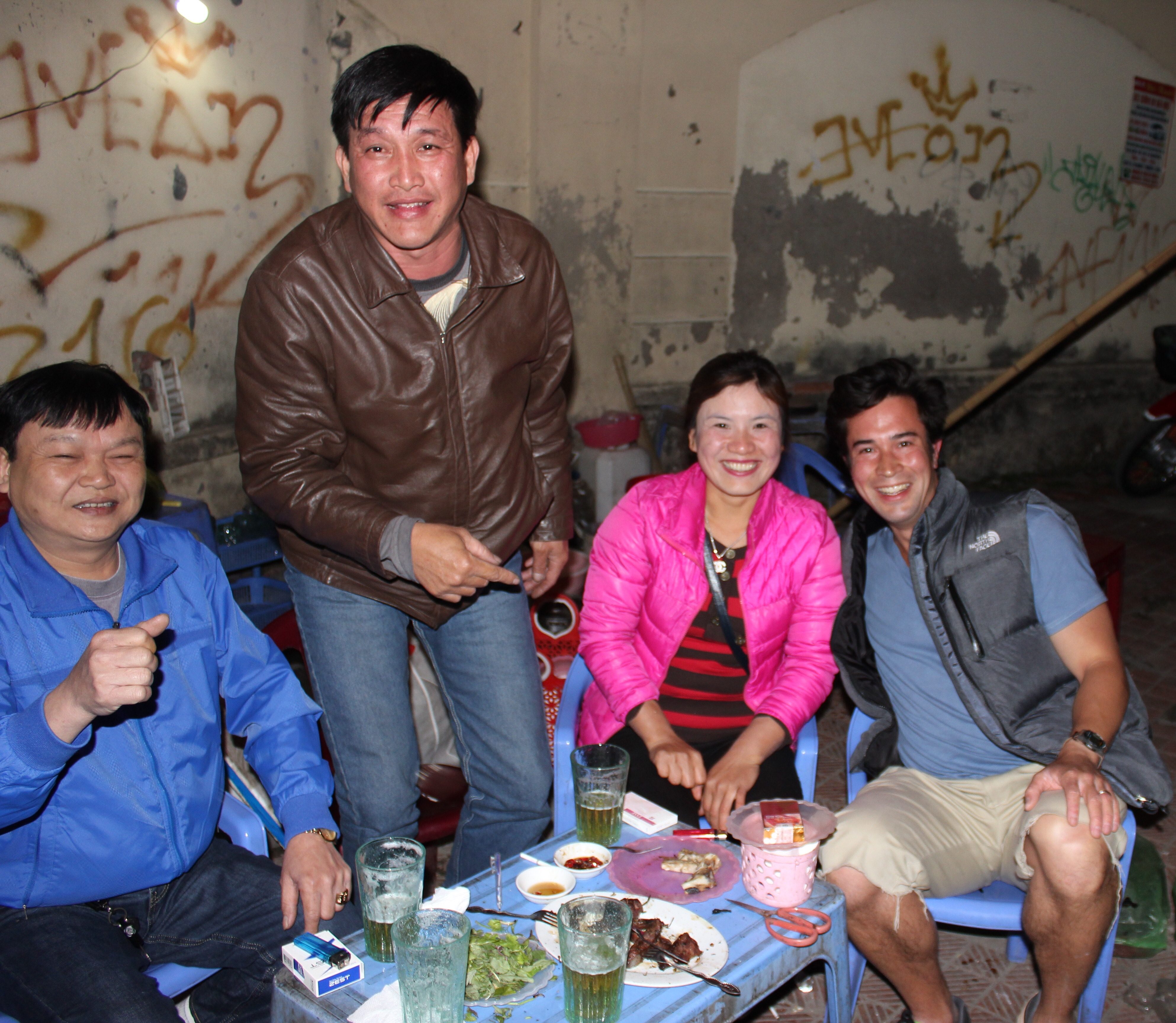
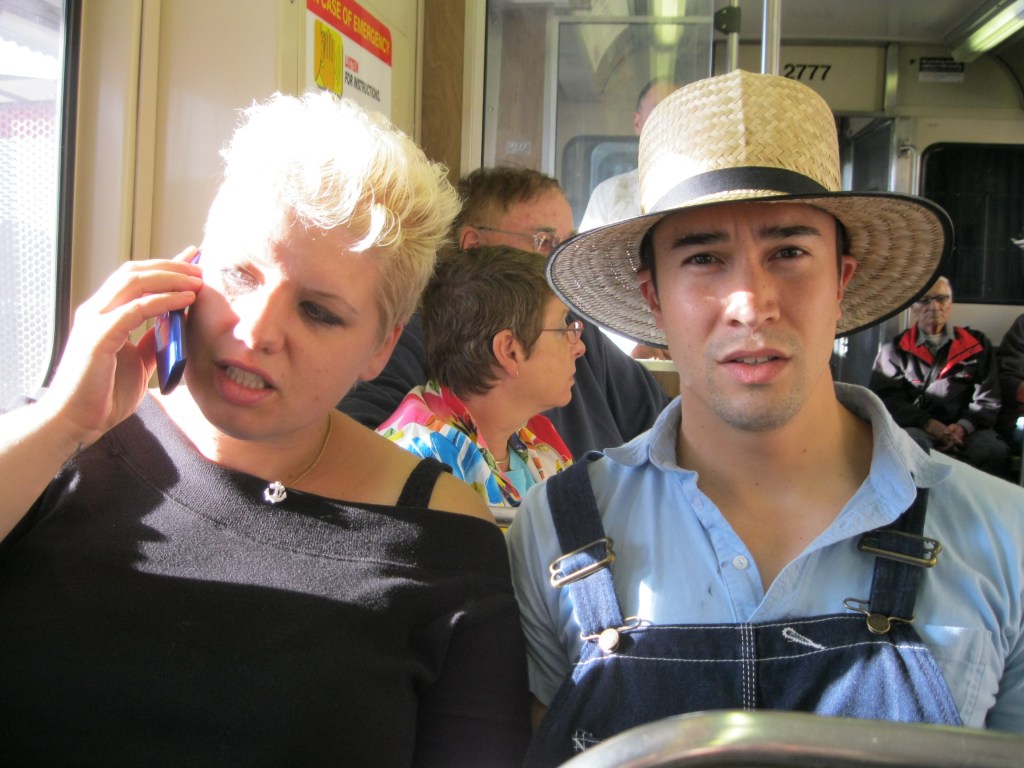
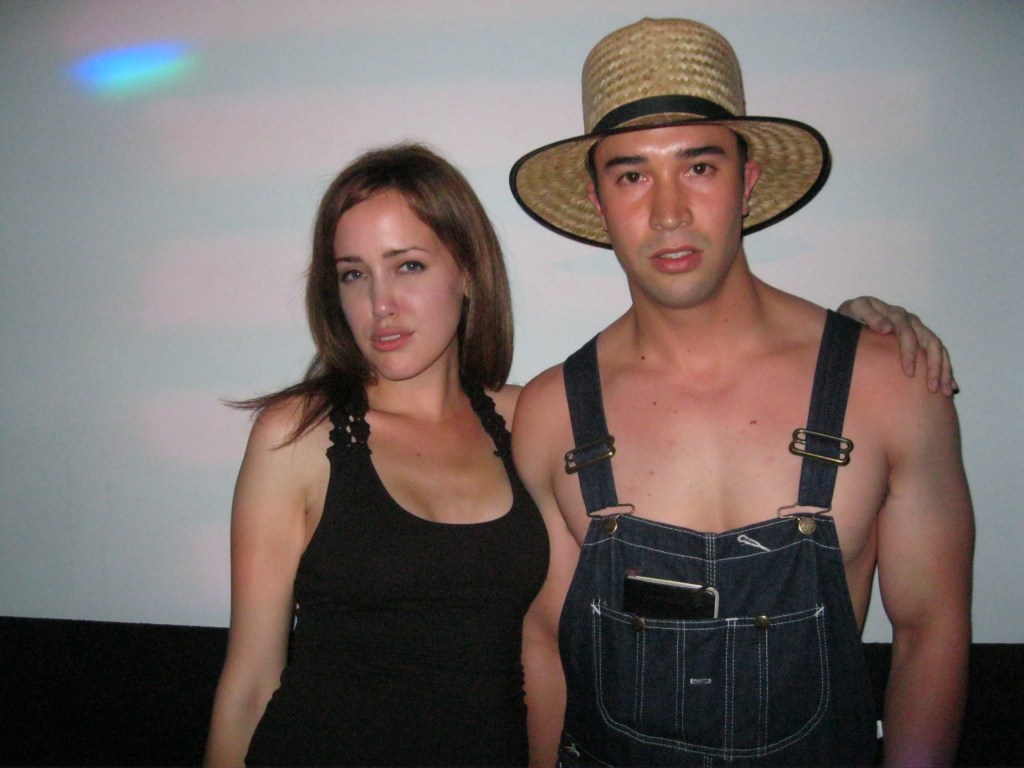
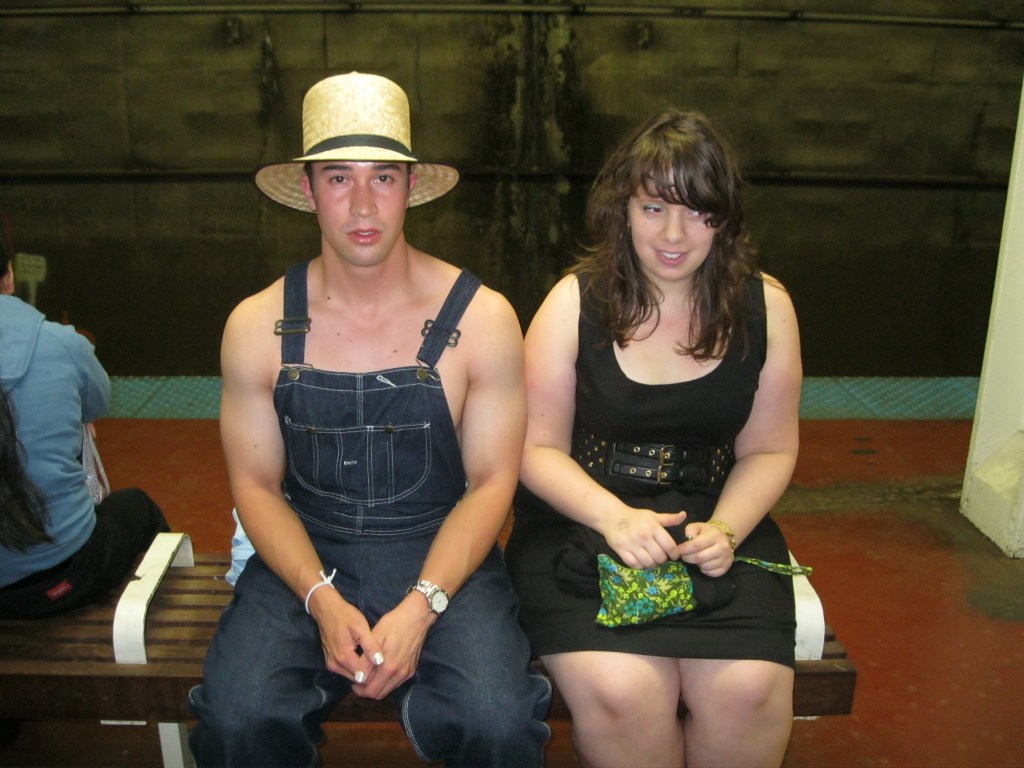
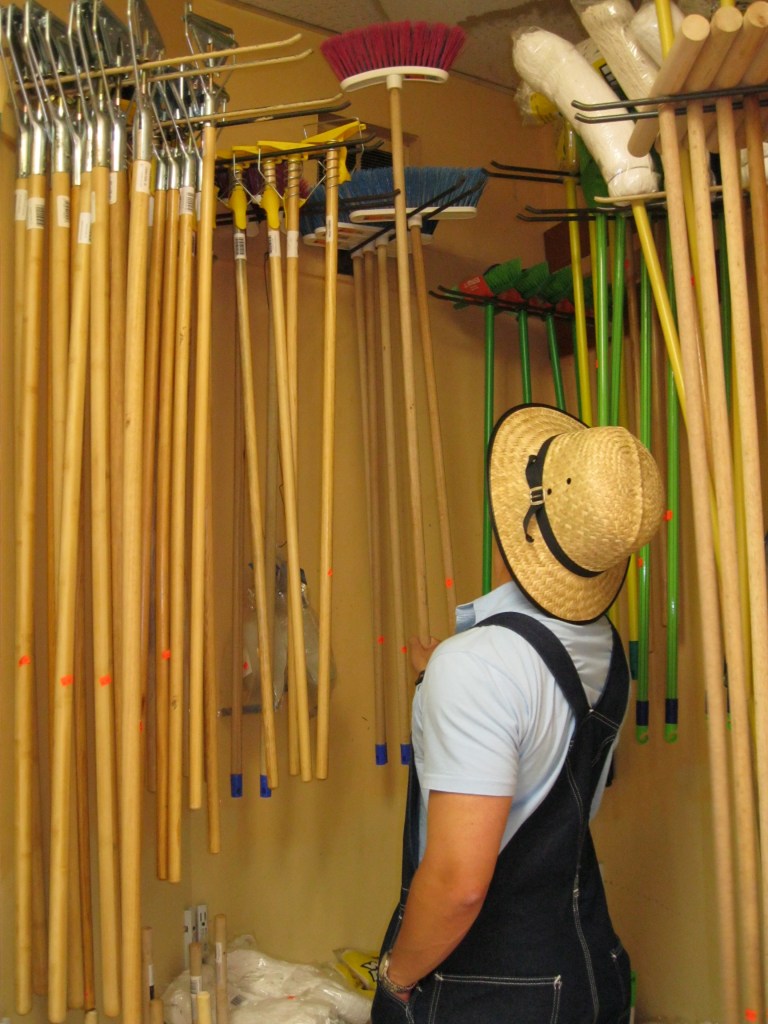
I was in San Diego, and Bianca moved to Japan again, then I moved to Barcelona, and then we were suddenly a few hours apart, me in Cleveland and her in Chicago. She would visit me for Thanksgiving, or Mickey Avalon concerts at the Grog Shop, I would visit her for special events. Then, one year, I agreed to visit for Labor Day. She said we should get coveralls and pretend to be laborers, but in my mind I thought she meant overalls, and then I thought it would be funny if I also pretended to be Amish for the weekend, which she thought was funny, and she announced on Facebook that her Amish cousin from Ohio was coming to visit her on Rumspringa, and so the most important thing I have ever done was set in motion.
In retrospect, it was incredibly culturally insensitive. I went around pretending to be Amish; the idea was that I had never really been off the farm, so everything about a big city was new to my pure, virgin eyes. I was astouded by the electric tools, the toilets in the windows of plumbing shops, the Mexican food, and the women. I asked people if I could get my photo taken with them, and then pretended I was not used to photographs, so I adopted a slack-jawed look while they smiled. I started off shy, but over the course of the weekend, I became increasingly outgoing, almost reckless, except it is hard to be socially reckless when you can’t be taken seriously. Bianca…she did more than enable it. She was part of the creation – a collaborator, a director, an executive producer. An artist. We met friends; I got drunk with a guy I met on the Megabus named Nik, and he and his girlfriend showed up at a bar with one of her friends, and all of them got in on the act. I interrupted a date at a pizzaria, and got my photo taken with the couple, then accidentally spilled a bottle of water all over the guy. I lost my shirt and we were in a gay club and Bianca had to dance up on me to prevent guys from hitting on me – one guy got kicked out for being too aggressive. A month later, I did a presentation on the weekend; for years, people referred to me as The Amish Guy. Years later, I was talking to a woman in a bar, and she suddenly said, “You’re the Amish guy! I presented at the same PechaKucha as you!!! But even though I did a presentation, when people ask me about PechaKucha, I tell them about you instead.”
I am lucky enough to have documented my proudest moment.
Then, for some reason, she stopped talking to me – I said something that pissed her off, and she blocked me on facebook and stopped replying to my messages. This must have been in 2011, because during the early days of Cash Mobs in 2012, she was eating breakfast in a hotel in Austin, Texas, when she saw me on CNN, and shouted “I know that guy!” And that was that; we were friends again, and haven’t stopped.
Now we write. Lots. Not emails, or messages – she fills notebooks with her letters, then sends me the full notebooks, which are like journals. She is incredible with words, so each feels like an intimate, contemporaneous, personal memoir from one of the best writers I have ever encountered, and I know that each notebook is made only for me. Her letters are one of the purest luxuries I can imagine. I try to reciprocate – I have my own paper preferences, and different time constraints, but writing her is one of my greatest pleasures after family. No – writing her is part of keeping in touch with my family. And whereas many of my correspondents are more transactional – they write me, then I write them, then they write me – with Bianca, we always have letters on the go, and we send them whenever, so they never match up; she might write me a response about something I wrote two months and three letters previous, and I might do the same. We have no expectations, so every page, every word, is a gift.
Bianca is someone I truly love, and I am glad she is alive.
“And did it matter if you marked your birthday on the wrong day? If it had really been the 25th of April, though you never knew. The wrong day became the right day. This was the great truth of life, that fact and fiction were always merging, interchanging.”
from “Mothering Sunday: Graham Swift” by Graham Swift
Books in March:
- Atomic Habits – maybe the third time I have read it, and oh, how brilliant and timeless it is.
- Mothering Sunday – I got this on a whim from a Kindle Daily Deal, and finished it in a couple of days. I got it right after the conversation with Alice, Marcello and Cathy, and it reminded me of a distinction that Marcello drew between fiction: some are character-driven, some are action-driven. Mothering Sunday is atmosphere-driven. It also drew connections between memory, and writing, and aging, in a delectable way. I don’t think I have ever read any book that has so thoroughly made me feel the still heat of a summery-spring day in a bedroom, the sun catching dust particles in the air, and the silence of the countryside, as this one.
- Do Androids Dream of Electric Sheep? – Chris, my swim club friend, loaned me this. It was a quick read, but enjoyable and thought-provoking; I don’t know that I would characterize Dick as a genius, but it was fun.
- Social Chemistry: Decoding the Patterns of Human Connection – this had been on my radar for a while, and Atomic Habits made me want to get it out to see if there are things that I should do. I stuck with it, but shouldn’t have. It is meandering and dull, with maybe one or two good chapters.
“I’m trying to tell you something ’bout my life,
Maybe give me insight between black and white
And the best thing you ever done for me
Is to help me take my life less seriously –
It’s only life after all.”
We don’t have television, but we each have videos that we show Daniel. I want him to see music videos and short clips of culture, so I started selecting certain ones to show him to see what he liked. March saw us get into a rhythm: first we would watch Big Ben Chimes Twelve, then Testify (one morning, he said during breakfast, “Testify is my favorite music video ever”), five minutes of trains, then the Indigo Girls (which makes me endlessly happy). Sometimes, I show him another video just for variety – he was asking for Plush for a few days, and then Hellzapoppin, and finally settled on Misirlou. Then, one day, I decided to play him Frank Zappa, and he thought “Why does it hurt when I pee?” was hilarious. The Spotify algorithm followed it up with “San Diego” by South Park, which he thought was even funnier, so we will listen to those on repeat, twenty times in a row, Daniel’s little head bouncing along. (“What’s gonocacacaca? (giggles)”) He also likes videos of tap dancing, but says he doesn’t want to learn to tap.
He still loves when we read to him, and is starting to pretend to read – he has memorized so many books that he can open them up and tell us what words are on the page. He asks us to show him how to hold pens and pencils and crayons correctly, then pretends to write things. He knows the lyrics to songs, and occasionally sings along, sometimes even in tune.
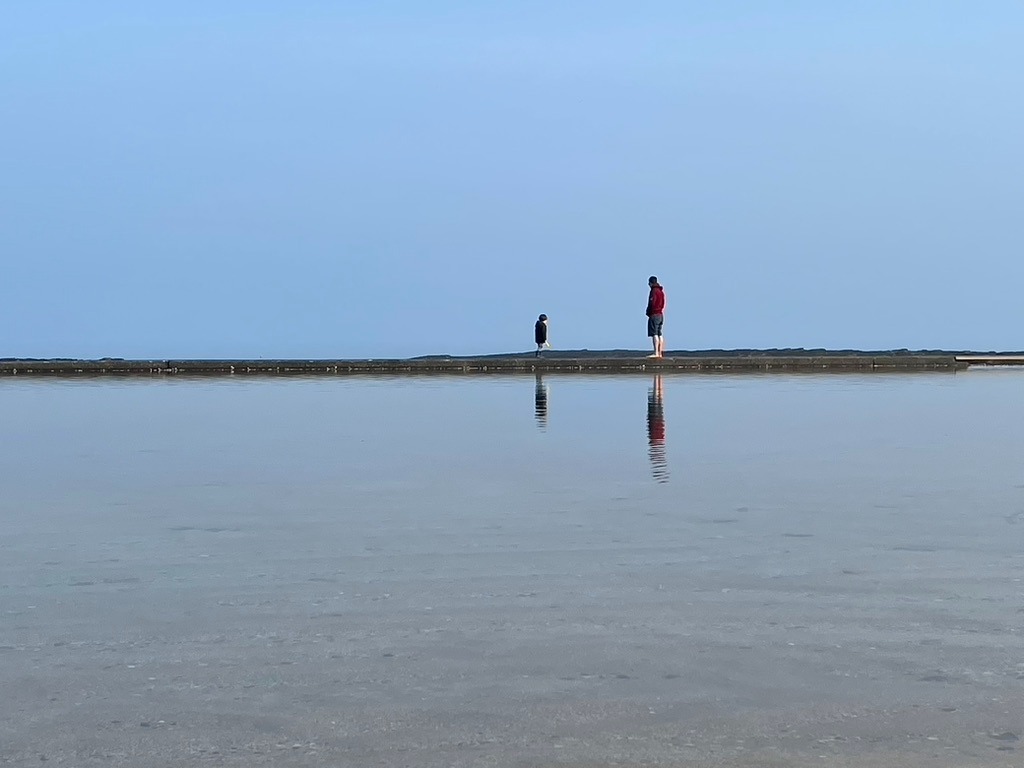
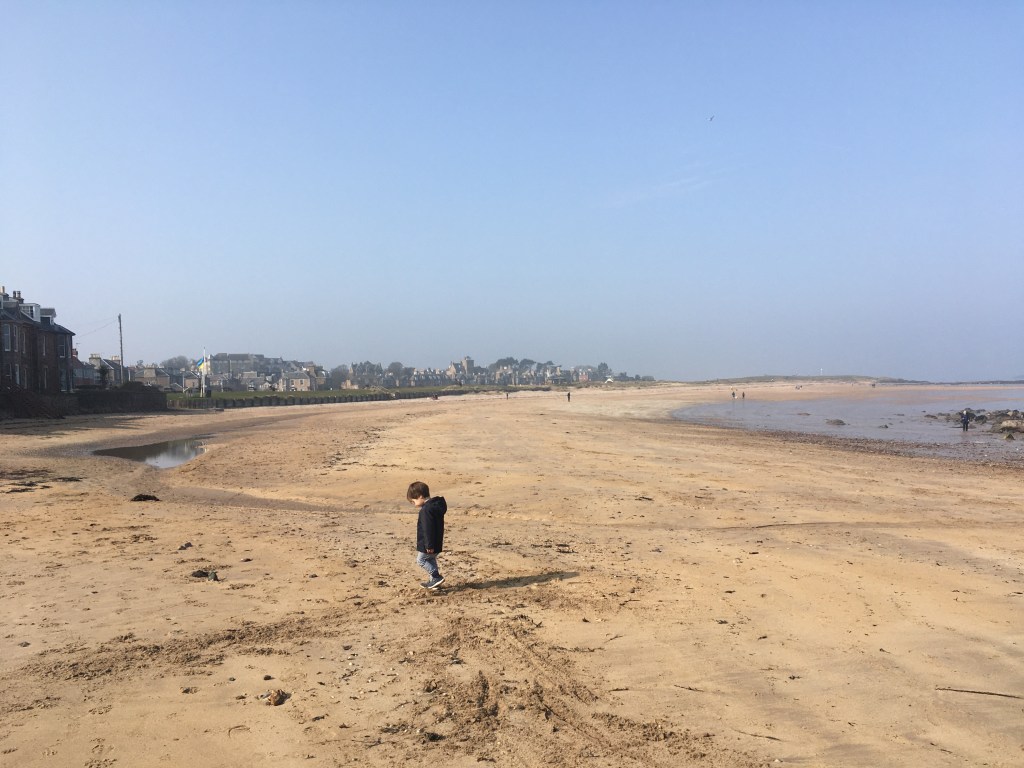
And he turned three. On his birthday, we took the train to North Berwick, where he dug in the sand, and we walked around, and then got the train home. We had a cake with Marcello, who is also his godfather, and Nina, and then he played with new toys until it was time to go to sleep.
Soon he will have parties. Soon, there will be more of us. But for now, this…seemed like what he needed. What we needed. Small gatherings, a nice day out, and a quiet time. For now.





 Andrew Samtoy