When I was growing up, my parents never took us to church. The reason they gave was that both of them were brought up Catholic, and had such terrible experiences that together they vowed that they would not bring us up in any religion at all. It never seemed odd; I think of everyone I knew, Ryan Albert was probably the only person who was a regular churchgoer, and I only knew that because his dad was a host on an AM radio station and talked about Christ.
But I had this friend, Jason. He lived in the Royal Estates trailer park on the other side of Pepper Drive, and had a Nintendo that he could play without any screen time limits, and BB guns he could shoot in the little astroturf patch behind his trailer whenever he wanted to go outside. His parents drank beer, and smoked, and ate store-bought cookies and chips and heated up TV meals for dinner. My mom would drop me off to see him and suddenly I was in a different world.
He didn’t go to church, either. Then, at some point, his parents decided to become Mormon, so Jason became Mormon, too. Automatically, it seemed, the Mormon boys were suddenly nice to him, and he got to hang out with the Mormon girls. I never thought about it then, but growing up in El Cajon, those were significant benefits. We didn’t have any gangs, but there were tribal elements to the social order, and the Mormons were a significant tribe. I didn’t do much outside of school myself; the most social thing I did was to ride my bicycle down to the 7-Eleven to play Battle Axe and drink Double Gulps with Gabe Feeley. My scholastic social standing reflected these extracurricular devotions.
Despite his new, far more useful social circle, we stayed in touch, and one evening in junior high, Jason invited me to a church youth group event. It must have been eighth grade, because I had long hair at the time, and the youth group was putting on a play about Moses; because of my hair, I was chosen to play the lead, majestically parting the seas and leading v1 of the Chosen People to safety. When my mom came to pick me up, I got in the van and told her that I wanted to start going to church. She carefully asked why, and I told her that I felt like I was missing out on a core part of a life experience, something that billions of people around the world found both valuable and fulfilling. There must be some benefit to religion, I observed, and I was being unfairly deprived from exploring it for myself in a liberal, open-minded way. I wanted to understand it from the inside, then accept or reject it myself, instead of being stopped from learning because of the blind, bitter prejudices of my parents.
She talked to my dad, and they decided that if I wanted to go to church, that was fine, but they got to choose the church. I thought: win. They did their own research, and then one Sunday, we walked into First Unitarian Universalist Church of San Diego , which was about the most fortunate thing that could have happened to my teenage self.
The UU church was in Hillcrest, about a thirty minute drive away. Hillcrest was the center of the gay community in conservative San Diego, and, at the time, it felt like the church reflected the radical acceptance of the surrounding community. There was religious education, but it focused on learning about almost every religion – I learned far, far more about Buddha and Shiva than Christ. And I was suddenly surrounded not by the conservatives of El Cajon, but a distillation of the ultraliberals of everywhere else who wanted to go to church but had not found a spiritual home they felt comfortable in. It wasn’t just the adults – I was surrounded by open-minded people my age, a group of peers who challenged everything and encouraged me to accept my self.
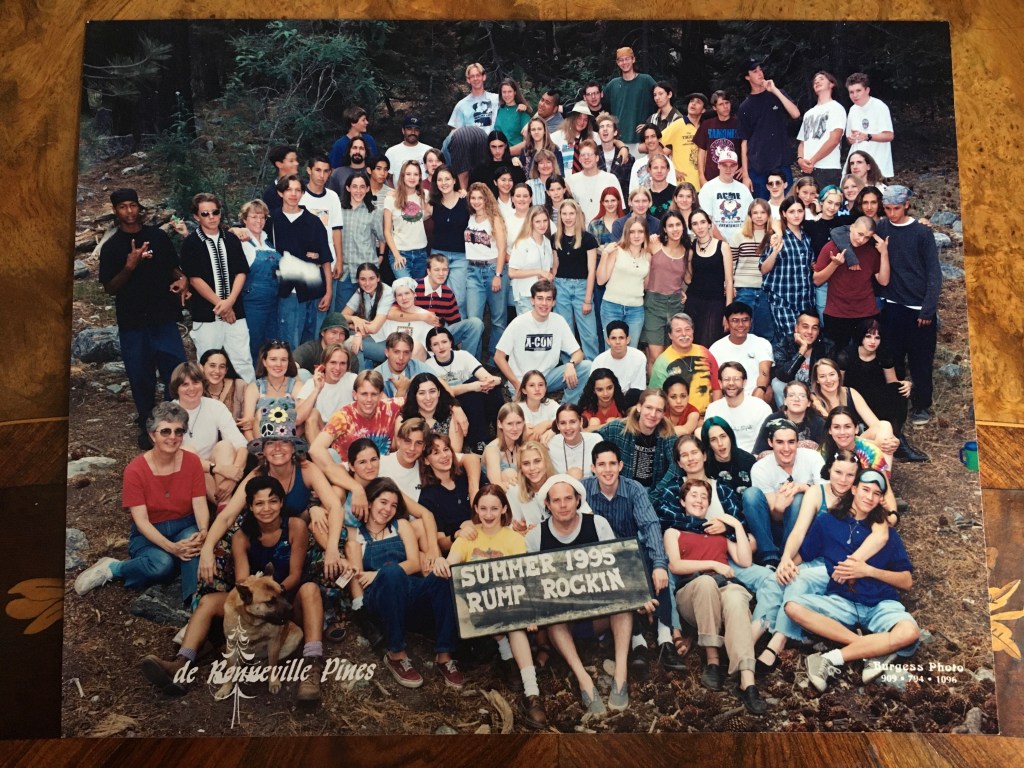
And the social events! Twice a year, in summer and winter, we would go to de Benneville Pines camp – 80 kids, maybe, from around Southern California, and often other places in the US and Canada, packed into cabins for a week without parents or curfews and seething with hormones. When we weren’t at camp, once a month, one church in the Pacific Southwest district would hold a “minicon” where the same kids were invited to spend the weekend at the church – perhaps 60 teenagers, and a handful of adults keeping us alive, if not actually safe. I was an active member of the Young Religious Unitarian Universalist community throughout high school; I had my social circles at Granite Hills, and a completely separate, far more consequential and influential social circle spread out through virtually every part of Southern California. For some reason, I kept these groups strictly compartmentalised – I don’t think I ever brought any of my school friends to church, or invited them on any of my adventures.
And this story begins one Saturday in the first weeks of 2001, when I was back at school in Claremont, on the eastern border of Los Angeles County. Lorna, a friend from camp, called to ask me to come down to LA proper. We had lost touch right after high school – I was focused on college, and she was involved in a thousand other hustles herself, but I had been in a television pilot that she had worked on over the summer, and when we hugged and said we wanted to stay in touch, we both meant it. She called, she said, to ask me for help; she and her partner, Moj, had just signed a lease for a new office space. They produced events, and they needed help setting things up, so I drove an hour in to LA in the early afternoon. I remember that it was sunny, and warm, in the Los Angeles way where you never really know where the sun is because it seems to be everywhere forever. I parked in front of their building; the door was open, and when I walked in, I was greeted by a huge expanse of empty space, and fumes, and two women on their knees with paint rollers in their hands. It turned out that they had spent all day trying to varnish the floors, and had done about a quarter of the room. I didn’t know anything about varnish, but I got down with them, and 45 minutes later, maybe an hour, the entire floor was coated and they were both happy.
I quickly learned that they were business partners, lovers, and were living together. We waited for a while, drinking tea in the back, then put on another coat of varnish, and in the late afternoon they asked me to come with them to “the house.” I protested – I had to get back to school, it would be a long drive, I had to study, there were people who needed to be seen – but they insisted, and it was nice to see Lorna again, and I wanted to get to know Moj better. I got in my car and followed them down Sunset, took a left on Micheltorena, and then went up an incredibly steep hill.
When they turned left, and opened a gate, I thought I must have lost their car and started following a similar car by mistake. They were entering a gated mansion, with immaculately kept grounds, at the top of the highest point in the LA basin. Lorna leaned out of the window and shouted that I had to come in really fast behind them or the gate would scrape the side of my car. I parked behind them in a large, circular driveway, wondering how someone my age could afford this with her girlfriend, who wasn’t much older. They walked in the front door with body language that I can only describe as proprietary, and a couple of guys were hanging out in the hallway, talking – one was super friendly and nice, and the other was the second biggest asshole I have ever met. Apparently – and I don’t really remember this, or what was said – Lorna and Moj quickly realized that if we weren’t separated, I was going to get in a fight with the asshole, so they pulled me away to meet their landlady – perhaps pleading that I had not yet met my host, and it was making me uneasy. Once out of earshot, I learned that the nice man was named Cuba Gooding Jr., and the other man was named Ashton Kutcher, neither of whom I had ever heard of; they were there to do a photoshoot for Jane Magazine.
(I wrote their names down – it was before smart phones, so I had to go home and get on a computer to google them. And now, 23 years later, and my memory being as demonstrably flawed it is, I doubted my experience writing this down; might I be misremembering who was there? What if it wasn’t them? Why did I so specifically remember Jane Magazine? I can’t say I had heard of it, either. But the internet is a wondrous thing. Look through the images; that is the Cuba I met later that evening, on the lawn, the city laid out below and behind him, and Ashton in, I believe, one of the hot tubs that Dana had made – she had taken the giant old water heater, the original one for the house, which had lain discarded for years on the hillside; she cut it in half, lined it with teak, put seats in, and turned it into two hot tubs that sat behind the house, hidden behind some trees.)
Lorna and Moj brought me to the pool and introduced me to Angela, the groundskeeper and personal assistant to Dana, the owner, and then Dana appeared. At the time, she was 38, which seemed impossibly old to me then. I liked Dana, immediately. My Dale Carnegie instincts appeared, and I asked her about her background; she had gone to art school in Chicago, she said, and decided to make it as an interior designer in LA; when that didn’t pan out, with her last few dollars, she bought some cheap cushions and covered them in her fabrics, the ones that she couldn’t sell in her shop. She took these covered cushions and sat by the side of a road, her trunk open, hoping to make enough for gas money back to Illinois. Within 30 minutes, she had sold them all; she went and got more cushions, covered them, and sold those, too, and suddenly her future in Los Angeles didn’t seem so dark. She stayed, built up a clientele, and then, eventually, was introduced to the owners of The Paramour: the Catholic church, who had been housing a group of nuns there. These nuns were not ordinary nuns – they believed that some people were touched with a Sixth Sense and could commune with the dead, and their nunnery was focused on housing nuns with these powers. Women who had these powers AND who wanted to become nuns were increasingly difficult to find in the late 20th century; the nunnery was on the decline, and they realized that they needed to sell the property. Two prospective buyers emerged: well-financed developers, who wanted to raze the house and build luxury condos, and Dana, who, the nuns recognized, not only wanted to preserve the house but also seemed to have this sixth sense. When it came time to sell, they lobbied the Holy See to sell to Dana. The Pope himself apparently signed the deed over. Dana used the house as a glorious showroom for her work – everything in the house was for sale, and she rented rooms out to Moj and Lorna and a photographer named Jack. Angela lived in a house across the street that Dana also owned, and there was an old dog, Mary, a flatulent shepherd, who followed Dana everywhere.
And it was beautiful.
Dana told me that the house had originally been paid for by a doting father who gave it to his daughter, Daisy, as a wedding present. It was built by a team of operative and speculative freemasons – men who understood how to lay bricks and mix mortar, but also how to design a building to touch the soul. It was built in a U-shape around a swimming pool. Viewed from above, the right half of the U was supposed to be for the couple, with large, outward-facing living spaces; the left half was comprised as small rooms – later used as dormitories for wayward girls, then nun rooms. There was a tower in the middle that led to a long room, where Jack lived, and, on the ground floor, a ballroom; because the masons thought of the universe and our place in it, they built the ballroom so that, on equinoxes and solstices, the light made patterns that were only visible on those days, and it had such good acoustics that bands recorded albums and Beck and Elton John had performed intimate, private concerts there. At some point, a whispering wall was built on the open end of the U; you could stand at one end of the curved wall and whisper, and it would travel 40 feet to the other side, where someone could whisper back to you, so, at parties, couples could arrange liaisons without ever appearing to come close to each other. Dana had a dream of turning the whole place into a rock-and-roll hotel, where bands could come and record in the ballroom, then stay in the house.
Ashton and Cuba left, and the Paramour was safe again. Lorna made dinner, and we all sat at a table by the pool, talking. It turned out Jack and I were connected by a mutual friend in San Diego, and he told me about his recent breakup, a career crisis, and finding shelter in the tower while he got his shit back together again. Dana left the table, came back, and gave me a copy of a book, “I Dare You!” by William Danforth, which she said she loved and had the feeling I would like, too. It felt like the cozy center of the universe, certainly the center of Los Angeles, but what I remember of that Saturday night was that in the middle of one of the most desperate, vicious, and uncaring cities in the world, it was so quiet, so personal, so intimate. So lovely. And, at some point that evening, when time didn’t matter anymore, I left, driving down highways that were magically clear of LA traffic, back home to my dorm room.
Lorna called; Dana wanted me to visit again. I started going there on weekends, hanging out with them and their friends – not the fashion designers or magazines who rented it to make their models look good, or the rich people who were buying furniture and paying for taste, but artists and writers and musicians that Dana simply approved of and accepted into her circle. For some reason – likely as simple as the fact that they lived close, and I lived far away, but I like to flatter myself that she liked me more than them – all of their other friends would leave, and I would spend the night in one of the bedrooms. I would take my contact lenses out in the downstairs bathroom, drying my hands on towels that cost more than I had ever had in my bank account, and then slip into whatever bed I had been assigned – always on the home side of the house. I would wake up, and we would all make breakfast together, and I would return to Pitzer, back to my dorm room in Holden with an old twin bed and industrial-wear carpets and hungover neighbors. Walking through the hallways, I would look around at my peers, and think that they could never imagine what I had just done, who I had just spent all evening talking to, the incredible company I kept, and so, again, I never told them.
One weekend, edging toward the Los Angeles spring, I went down for a barbecue – as was more often the case, just me, Dana, Lorna, Moj, and Angela. We were outside at the table and Moj asked for something; I jumped up and went into the kitchen to get it. The kitchen had a long storage corridor connected to it, lined with cupboards. Closing the fridge, I saw a sudden movement out of the corner of my eye, and looked down the corridor. It was empty, as far as I could tell, and I went back outside and asked Dana if she had got a cat.
“No,” she said, “why?”
I told them I had seen something jump from one side of the corridor to the other, and they all stopped and looked at me.
“He saw her,” Lorna said.
Dana then explained that Daisy’s marriage had been unhappy. The screen actor, Antonio Moreno, was unfaithful to her, and, at some point, Daisy got fed up with his philandering. The house was at the top of a long, steep hill that my car always struggled to climb; one night, furious at some new revelation or accumulated slights, Daisy got into her car, pointed it down the hill, and never put her foot on the brakes. Moreno was kicked out by Daisy’s father, and the house ended up for sale. The nuns knew that her ghost still haunted the house, and when Dana visited, they realized that she was touched as well; that was the real reason why they wanted her, and not the developers, to buy it. Dana had had an intuition about me, and she confirmed it on that sunny, slightly chilly Sunday afternoon.
One week, Kevin Costner came in and bought most of the room I had stayed in the weekend before. Dana just filled it up again from her warehouses, and the next time I visited, I slept under a blanket that smelled like a century of incense.
That spring, Diesel rented out the house for their Autumn, 2001 show. Part of the agreement was that Dana could choose some of the models, and I was asked to save the date. At the last minute, some of the other models cancelled; knowing I was at a college and surrounded by young, fit people, Lorna asked me to round up as many hot, skinny students as I could, so a few hours later, Mike, Sean, Lani and I all drove down. We arrived early, and I gave them a tour. I demonstrated the whispering wall, then we walked toward the ballroom; I said hello to a pretty blonde by the pool, and after she passed, Lani grabbed my arm and told me that it was Sarah McLachlan, who I think was staying there for the week. For the show, we all wore white jumpsuits with nametags that said “Barbara,” and showed groups of drunk magazine editors and fashion lovers around to mannequins wearing clothes from the collection. At the end of the night, when things were winding down, I snuck around to the back to the hot tubs, turned one on, stripped down and slipped in. As the sounds of the DJ cut off, and the voices died down, I soaked in the ultimate luxury: being accepted.
I graduated and moved to Portland. When I came back, Dana was ill – I think she was battling cancer – and Angela went to rehab. Jack left to become a hobo, riding trains and taking pictures. Moj and Lorna had split up romatically, but were working together on their business – I believe at that time they were doing all of the production work for a new, big party in the Coachella valley that was gathering traction, but it was difficult for them to keep working together, even as their business thrived. I moved to San Diego, and checked in on Moj to make sure she was doing OK, but the check-ins became less frequent, and at some point it didn’t occur to me to call her. I moved to Barcelona, and one day I was in the DiR gym in Gracia. They always played American music videos on all of the televisions, and an image appeared, and I stopped and stared.
Britney Spears crashed her car into the pool, and my immediate thought was to worry about the tiles, and wonder what they did with the whispering wall.
I have lost touch with all of them now. Angela, I will never know about, or Jack – I don’t even know their last names. Lorna, too – she dropped off facebook, so the last thing I know about her is that she married a man, changed her name, and her kid is a genius at math. Moj is a titan in LA, runs an expanding business empire, is married to another Persian, and has a son, who looks adorable and fashionable and is photographed hanging out with Ariana Huffington. When I see posts about her success, I think of when she told me the best business advice she had ever received: “Always reinvest everything you can back into your business. Always.” Dana still has The Paramour, but got in a very expensive fight with Katy Perry, and I read that she went bankrupt from it, which is why I absolutely hate Katy Perry. The internet tells me that I could go spend the night at the house again, but I’m pretty sure my room would be on the dormitory side, and it would cost $1,500 a night. If I did, I wonder if Dana would recognize me, if I would recognize her. If I would see Daisy.
When the builders were renovating our apartment, they found that the floorboards – 200-year-old Norwegian pine – were all still in excellent condition. They restored them, but in one small spot, they didn’t do all of the staining that they needed to do to make the boards all the same color, so once every week or so, Alice varnishes the floor to try to get the color right, and every time I pass that spot, which is 20 times a day, my brain floods with thoughts of Lorna, Moj, Dana, Angela, Jack, Mary, Sarah, Daisy, Sue-Ling, Ashton, Cuba, Lani, Sean, Mike, Audrey…
We tend to treat ghosts as if they are the remains of dead people, the near-tangible spirits, whatever it was that the nuns and Dana and I saw. The ghosts I see, the ones who haunt me every moment of every day, are almost all still alive, are the people who have touched me and who still touch me. They aren’t the dead, they just aren’t part of my life, and I see them every time I see a sailboat, or hear the Indigo Girls, or flick open a Zippo to light a stranger’s cigarette, or put my socks on before my pants, or think that it is a warm, green rain,
with love
in its pockets
for spring is here,
or put carrots in a pan at the beginning of a stirfry, or fill a pen, or hear Tupac blasting from a car stereo, or see a golden retriever swimming, or blow my nose in a handkerchief, or see a bottle of Johnnie Walker Red behind a bar, or a thousand other things that, for other people, might not bear a second thought except that for me they do, they absolutely do, they fill my head with a thousand thoughts of love or wonder or anguish at my life long gone. My days are filled with these sightings; my life is just a ghost story, an accumulation of hauntings.
And before last Sunday, every time I lit Morning Zen incense, I thought of Alex Clark, who was alive, and who I never called even though I promised to, and now never will.
Alex: thank you for making my life so much richer, and for giving so many people so much happiness. I hope you rest in peace.


What a great memory. Ghosts—they haunt our memories, more often than not with lingering sweetness. I think I know who was the second biggest asshole. That begs the question of the first. Started me thinking about who’s on my list. Fun, thanks!
LikeLiked by 1 person
Tom K. says rapping is the ultimate luxury, but you raise a good possibility here as well.
LikeLike
[…] portrayed on the worst television, or the best movies. In the best parts, we are surrounded by celebrities, and in the worst parts, we are surrounded by violent, gun-toting maniacs. The America I know and […]
LikeLike
Samtoy! I was made aware of your blog last night at dinner with old YRUU pal Meredith (Phil KC, Caitlin and Justice also in attendance). I’m happy to see you’re still writing on the internet, I check in on the sandwich board occasionally and have been bummed to see it go dark. I loved this entry, in particular. Miss you, love you and hope our paths cross again someday (maybe on a walk to the Hillcrest jack in the box).
LikeLiked by 1 person