
I often hear Alice telling Daniel that she doesn’t want him to use curse words. For me, it is more important that he learn context. Therefore, I don’t censor myself around him much, or demand that he not use curse words, provided that they are in context and not inappropriate for the company he is in. He knows that cursing is inappropriate in certain circumstances, so I figure he is good – and if he gets into trouble, he will learn.
But one night in late October, he was playing somewhere and I was doing the dishes. Something he had said earlier made me want to hear “21st Century Digital Boy,” and hearing that made me think, “I haven’t heard ‘Fresh Fruit for Rotting Vegetables’ in a while.” So I asked for it on Spotify, and suddenly chords I hadn’t heard in 25 years came out of the speaker.
I zoned out while doing the dishes, and then Daniel came in to ask me something. I told him I loved him, and he scrunched up his face, contorted his body, and jumped in the air, which he always does when I tell him I love him and which I always laugh at. But just as I laughed, I heard Jello Biafra chanting,
“Kill kill kill kill kill the poor,
Kill kill kill kill kill the poor,
Kill kill kill kill kill the poor, to-ni-i-i-ight…”
And my immediate thought was: I can take it if a teacher tells me Daniel said “shit” or “fuck” or “goddammit,” and we can discuss context and acceptable use. There is no way whatsoever, no circumstances, no contexts, where it is appropriate for him to chant most Dead Kennedys choruses.
So I said, “Alexa, stop.” The music stopped. Daniel crab-walked to the door, seemingly oblivious to our near-catastrophe.
I guess we are both learning.
It will always be a victory when a pen runs out of ink.
I got back into Pulitzer books in October and November. First, my sister sent me the Jonathan Eig book King. I had just read Marable’s brilliant book on Malcolm X, and have been looking forward to reading about MLK as a contrast; I know very little about King, so I was excited to pick this up.
Recently, I was reading the introduction to another book, and the author made the argument that biographers owed it to the reader not to simply summarize a life’s events, but to make the reader understand the full context of that person’s life – to know something about the situations they were placed in, what they felt, what they would have seen when they walked outside of their front doors, the kind of fabric their clothes were made of, what their office smelled like, what they liked to eat as a mid-afternoon snack. King did none of those things. For the most part, it was a list of dates, people, and actions, with very little meaning. A random passage might read, “On (date), King and Abernathy went to Chicago. The next day, he spoke to a group before heading to California, where he stayed in Los Angeles before flying back to Atlanta the following Saturday.” Outside of an excellent section about the Montgomery bus boycott, and why it was so important and meaningful, I didn’t get a sense of who King was, or what his life was like. The most vivid image of what he faced every day came at the end, when Eig mentions that he had a Cross pen in his pocket when he was shot. That may say more about me and my preference for Cross than it does about the book, though; it may have been just as forgettable for someone who doesn’t have a long history with Cross.
I then turned to two biographies that, unfortunately, were published in the same year. First, I re-read Logevall’s JFK, which had the misfortune to be published in 2020. If it had been published in 2022, and had come up against King, I have no doubt it would have won the Pulitzer – it is detailed, subtle, and beautifully written. Logevall occasionally writes like a true-believer fanboy, whose subject can do no wrong and is always justified in his actions, but the reader comes away with a sense of what America was like for Kennedy, in particular, in the early part of the last century, down to the smells of his dorm room and the taste of the late-night bowling alley hamburgers and milk shakes he consumed on the campaign trail. It is one of the rare biographies that can be re-read with pleasure, on par, almost, with Caro.
And then I read the book that beat it for the Pulitzer: The Dead Are Arising. I started it with a bit of fatigue – I had been so immersed in mid-20th century American racial politics for the last few months, did I have the bandwidth to read more? But the father-and-daughter Paynes team do a masterful job in bringing out so many new complexities of an already-rich subject that it was easy to see why it won. By interviewing so many people who knew X, the Paynes were able to paint a much more vibrant picture of his life than X and Haley could do on their own, and Marable was able to do by relying (I suspect) mostly on documents and archives. One gets an understanding of the America that X (and King) faced – the desperation of his youth, the lure and lights of Boston and New York, and the pull of the Nation of Islam, and one is left with the sensations of his life as well – the smell of freshly-pulled potatoes being sold at the roadside stand outside of his childhood home, the clang of the railcars when he sold sandwiches on the Eastern seaboard, the sound of the car tires outside the jazz clubs of Harlem and the smell of sweat and perfume from the smoky dance floor inside, where he pushed weed and prostitutes on soldiers during World War II, and the cold of his jail cell, where he stayed up late reading the dictionary and planning debates. Come to think of it, I have never figured out why some biographies resonate with me and some don’t; I can’t stand to pick up biographies of the Founding Fathers, for example, because they seem so disconnected from the lives that the subjects must have actually lived. Caro, Logevall, the Paynes, Rich Cohen – they bring their subjects to life, and deserve all the success they have received.
There were a few non-Pulitzer books as well. Two I read for a potential project I am pursuing: The Opposite of Spoiled and The Marshmallow Test. I have been happy to read pop-psych books over the last ten or twenty years, but after ten months of mostly Pulitzers, these were almost painful – dull, repetitive, drawn out, with the sort of style that implies that there are incredible secrets hidden within the chapter for those who study it closely and are smart enough to divine the necessary lessons within. I think I would have learned more from a five-minute YouTube video on each of these.
But if those were dull, I was incredibly disappointed by Breath: The New Science of a Lost Art. I had heard a lot of good things about it, and was excited to dig in, but was sorely disappointed – on the one hand, it seems to some good advice in certain places, but on the other, much of it is buttressed by support that is suspect, at a minimum, or conspiratorial at worst. In a few places, he writes, in essence, “This study supporting my point was conducted XYZ years ago, and has never actually been disproven, so it must have an element of truth to it…and if you haven’t heard about it before, it’s because they don’t want you to know.” By the end, I was rolling my eyes every chapter.
Finally, prompted by the war, I read Palestine by Joe Sacco and Maus, a Pulitzer-winner by Art Spiegelman. They are both beautiful, devastatingly beautiful, dreadfully beautiful, gut-wrenchingly beautiful, and I don’t recommend reading them both back-to-back within seven days. Often, I think that a picture may be worth a thousand words, but most of the time people use too many words as it is; here, each image conveys so much more than mere text could, and renders the subjects in heartbreaking clarity, that it made me think: I have never been interested in graphic novels, but there will always be a space in my life for graphic portrayals of terrible tragedies.
Every night, before bed, Daniel has a “midnight snack.” Usually it is toast, or cereal, or porridge, or some fruit. He eats, and I either read to him or do dishes.
One night, he was eating and I was at the sink, and we were talking. He said, “Daddy, listen to this. ‘No’ and ‘Know’ mean different things. Like, you can say ‘no’ to something, and you can ‘know’ something,” and he tapped his head.
So I stopped washing dishes and sat next to him. For maybe ten minutes, we thought up homonyms. I would come up with them and he would laugh. His favorites were “for” and “four” and when I said, “they’re in their house over there” – he nearly fell off of his seat laughing, and I was worried he was going to throw up his toast. At the end, he said, “that’s a silly language.”
I keep thinking that I couldn’t be more proud to have him as a son, and he keeps proving me wrong.
Also, on schedule, Daniel is now into dinosaurs. It happened overnight; from diggers to fire engines to ichthyosaurs.

I was very young – perhaps Daniel’s Age – and I was out at some sort of luncheon with my dad and some other adults. I remember walking from the kid table to the adult table, touching my dad’s arm, and telling him I needed to go to the bathroom. He was laughing at something, and he turned to me and said, “Number one or number two?” with smiles in his eyes. I had never heard of this division, and didn’t know why it mattered or what it meant, but “two” rhymed with “poo” so I said, “two.” He got up, took my hand, and brought me to the bathroom.
I don’t know why I remember that, of all things, from my childhood; I remember very little else. But I think of it a lot now, because I have started to create a secret language with Daniel. One day, I was doing something, and I heard him shout, “I NEED SOMEONE TO WIPE MY BUM.” I don’t want to shame him, but I thought it was not necessarily the best thing to shout in potential company, so I ran to the bathroom and got my conspiratorial face on.
“Daniel,” I said, “I have an idea. From now on, when you need someone to wipe your bum…” I thought. “You should shout, ‘ELECTRIC BOOGALOO.'”
He thought for a beat, and then started laughing. “Let’s try it,” I said, and walked out. He shouted, “ELECTRIC BOOGALOO” at the top of his lungs, I walked in, wiped his butt, and then we washed our hands.
I have never seen the movie Electric Boogaloo, never listend to the song Electric Boogaloo, and know nothing about anything related to Electric Boogaloo. I don’t know what the long-term ramifications will be. I don’t know if any of his friends at nursery know, or if he has ever shouted it at the staff, expecting them to come running. But every day, when I hear him shout “ELECTRIC BOOGALOO,” I think: one day, maybe he will pass this on to his own kids, and it will make him smile.

When I was young-ish, maybe second or third grade, I remember walking with my family. My dad reached out to take my hand, and I shouted, “I DON’T WANT TO HOLD YOUR HAND!” I don’t think I ever held his hand after that.
I am dreading the days when Daniel and Nick do the same to me.
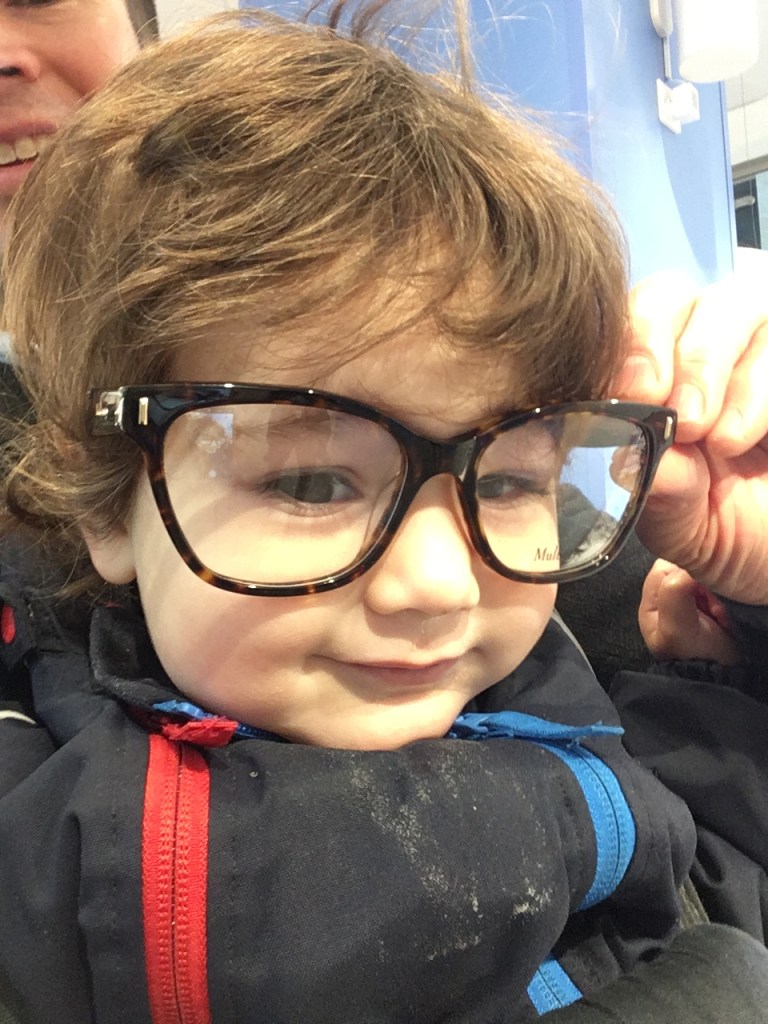
Nick is love. He is smily, friendly, and eager to be involved in the world. Above all, he is cuddly. He will shout “Cuh-coh!” and barrel into people, wrapping his tiny arms around anything he can get hold of, mostly legs, and then he pushes his forehead in and snuggles – not for a brief moment, but for ten or twenty seconds. He is sick a lot, and his nose runs, and he will come to us and say “Tiss-oo” and hold his face out so we can wipe the rivers of snot off of it.
He is more and more a joy every day, to everyone but, it seems, Daniel, who mostly tolerates him but often just shouts “NICK! NO! I DON’T WANT TO CUDDLE!”
And, thankfully, he often interrupts me when I am doing something – cooking, tidying, dishes – and reaches up and says “walk walk!” Then, he takes a hand, and we just walk around the apartment without any sort of direction, just looking at things, together.

Sometimes, I wonder what life will be like at the end – what the summary of my life will be. Will I have done things I am proud of? What will I regret? Who will Daniel and Nick think I was?
That’s what, I guess, I have to plan.

 Andrew Samtoy
I recall two biographies I particularly liked at the time I read them. One was Parting the Waters, by Taylor Branch, the first of a trilogy about the King years. The second was David McCullough’s biography of John Adams. Both exceedingly brave men.
I envy the happiness that I know you and Alice are feeling at this time in the life of the boys. And for Christmastime with them! Lots of love.
LikeLike