Everyone in the W. D. Hall Elementary School Class of 1991 will remember Brian Wilcox. He was wiry and tough and fearless, and I think he got in enough fights that he had a reputation for viciousness, for literally punching above his weight. He had anger issues, I’m sure, but was smart and engaged enough to get into the Honors classes; he read more, and more deeply, than anyone else in our class – just not necessarily in subjects that would help him in elementary school. He had practical, hands-on learning – he could work on cars from watching his dad, and fix bikes, and fish, carve wood, fix lunch box hinges and locks, and play any game in the playground. And he was charming, endearing, and, despite his regular fighting, often showed a tenderness to other students, animals, and younger children that made my mom think he was a “good kid,” worthy of coming over to our house for dinner whenever he wanted, and eating three or four times what she always thought he would eat. He seemed to like me, and in elementary school, we formed a strange friendship. It often involved him coming over to my house to play video games and ride our bikes around the streets, or me going to his house to do the same, and to go fishing in the stream around the corner for crawdads, which I don’t think we ever actually caught, and, now that I think about it, was probably actually a sewage drain, or to set off black cats and bottle rockets in the sage brush in the hills. Think about two pre-pubescent kids in the hills of undeveloped East County San Diego with multiple spare boxes of matches and bags full of smuggled Mexican fireworks, shooting them off into the dry weeds without any thought of fire risks; it seems insane now, but this took place in the 1980s, and it was a simpler, more trusting time, and nothing bad actually happened, which might be proof of a higher power.
One day early in eighth grade, I was in English class at Greenfield Junior High, second row from the left, front desk; Brian was sitting directly behind me. Every day, he would mutter things in my ear, or pass notes, or comment on the teacher, or just want to have a one-sided conversation with me, because he knew he could whisper and I couldn’t turn around to talk back, and I would probably laugh at whatever he said. On this particular day, early in the year, he proposed that we both grow our hair long. I don’t know why it seemed like a good idea, but until that spring, I didn’t get another haircut, and Brian didn’t, either. My parents supported me, although I should ask them, now, what they thought of it. My mother probably saw it as a harmless opportunity to let me express my teenage individuality; in the spring, she bought a pair of clippers, and we went to the back yard and she buzzed the sides down to a one a la Chuck Mosley. Brian, I believe, just let it grow, trimming the curly ends occasionally, and ended the year with the look and swagger of a fourteen-year-old Jim Morrison; his little brother, John, grew his long blond hair out, looking more like a Renaissance Baby Jesus.
I had that haircut for five years, until April 1997. In an unexpected way, long hair became a Samson-like source of social strength for those five years; while it didn’t help me attract the favors of Nicollette Stolis or ZeeZee Daher, it, plus the fact that I was 4’11”, made me a non-threat to virtually everyone in the school, and allowed me to fly under the radar by lowering everyone’s expectations of me. I remember one freshman year English class with Mrs. Jordan, maybe after our second or third assignment, when she asked me to stay after class so she could talk to me about one of my papers. By that point, I was well into my Unitarian Universalist punk phase, so I was probably wearing khakis that were six sizes too big, the cuffs either shaggily cut or rolled up, maybe a US Postal Service shirt that I had picked up at AMVETS, and Simple shoes decorated with Sharpie drawings, and I would have walked up from the back of the class, where I always sat “so nobody can get behind me” (I hadn’t even heard of Hemingway at the time) up to her desk in the middle of the room. After everyone had filed out, she handed me my essay, which was unmarked except for a big “A” circled at the top. ”You’re not actually stupid, are you?” she asked, her eyes boring into me. I looked at her, and her look instantly changed, and told me that she was amused that I had thought I could get away with deliberately lowering her expectations of me so that they would be easier to exceed, and that she appreciated that I was doing something that other kids would never think to do. I just looked back at her and probably shrugged, maybe smirked, probably drew my lips tight to say, “no, I’m not; you got me.” ”Good job,” she said, dismissing me with an amused wave of her hand, and when I walked out, I had the feeling that our relationship had shifted, that we were cool, and also…I HAD tricked her, at least for a minute. It was then that I decided that my motto, my approach to school, would be to “overestimate and be underestimated”; I would do what I could to get people to not take me seriously so that they would be surprised when I did anything worth doing. For her part, Mrs. Jordan made it clear that she had high expectations of me, and expected me to put in effort for both her and also for myself. English became my favorite class, and even if I was negligent in math or science, I strove to never let her down.
At the end of the year, at the end of the last class, Mrs. Jordan asked me to stay after class again. Everyone else filed out, some giving me worried looks, and I walked up to her desk for the last time. She stood up, all five feet of her, an inch taller than I was, and looked me in the eye. “Take care of your girls,” she said, and I knew she meant Ananda, Kassia, and Jarmilka, who were my three closest friends in the class. ”They’ll need you.” That was all. I hope we hugged, because I think a year later she retired, and then died sometime in the summer after her last class. Ananda, Kassia and Jarmilka were waiting outside the classroom door for me; they asked what she had said, and I told them, and I think Ananda took my right arm and we walked toward our lockers, me and my girls.
Except for Mrs. Jordan, and actually all of the other English teachers I had, who saw straight through me and treated me like a normal student, my “be underestimated” game worked brilliantly. Without realizing what Mystery and Style were going to do in LA in just a few years, I was peacocking; other guys didn’t see me as a threat, and girls seemed to think I was interesting, or at least different than most teenaged boys. Whereas in elementary school, I longed to fit in, yearning for a pair of expensive Reebok Pumps and Stussy shirts to be like Jason Seiler or Brandon Thomas or Shawn Curley, now I was looking to fit out, to look unlike anyone else at school, and in being different, it felt as if I could be myself. Thrift stores gave me cheap giant khakis, and work shirts, and then huge suits – I would show up to school in an oversized Ralph Lauren jacket and slacks, with a 1970s Christian Dior yellow silk tie, in thrashed skater shoes with white spats that I always wiped clean, women’s sunglasses, and a toothbrush jutting out of my mouth, my long hair flowing in the East County breeze.
And this combination opened doors; I fit in with a wide swath of 1990s Southern Californian social groups in a way that conventional kids could not. I would get to school early to hang out with the punks, which included my girls, Agata, and a bunch of goths, all in black and white, who talked a lot about music; I can still hear Ananda singing “Blister in the Sun” while Kassia applied Chapstick to her nose, claiming she was addicted to it, and Agata screamed “HE’S SO HOT” about Anthony Kiedis or Billy Jo Armstrong or whoever she was obsessed with at the moment. My hair, and clothes, let me blend in seamlessly with them, or at least made me seem like I was a fellow outsider. When the first break of the day came, I usually made it to the skaters, who were mostly boys with names that started with “C” like Carlos, Caleb, Clay. Students were unable to have skateboards on campus during school hours, so none of them had this critical identifying prop; my hair, and the bagginess of my clothes, must have made it seem as if I might have skated, just not in the same places as them. Their topics of conversation were often food (which they never had enough of, but which I could often supply) or skateboard parts (which they never had enough of, and which I had no idea about). Occasionally, the talk was about one of them being approached for a sponsorship deal, which I didn’t understand at the time but, in retrospect, I am awed by. I wonder now if any of them ever made it big; I think, at the time, they just wanted a steady supply of wheels, trucks, and decks to destroy. Later, lunch started with a stop to eat quickly with the hippies, including Brian, Angel, and Megan, who often spoke of esoteric matters and the Grateful Dead and weed, before I walked over to sit with the stoners, mostly talking with Tanner, then the punks and art kids like Jackie and Jenny, and, by the end of Senior year, I also had to hang out with the theater kids before classes started again; if I passed the nerds, who I had most of my classes with, I would talk to them, too, although they usually had some academic group to attend to, and spent lunch in classrooms, or in the library, playing Magic. I even remember the head of the skinheads on campus being polite to me whenever he saw me, although we had diametrically opposed hair cuts, and I don’t know if he knew I was mixed race. The only groups I didn’t spend time with were the jocks and cheerleaders; they had their own particular rituals and values, mostly around sports and alcohol and sex and religion, that I didn’t understand and so took no interest in.
Looking back, I am proud of El Cajon to think that all of these groups existed with so little outward strife between them. Maybe I am mis-remembering; the only big fights I remember were Jocks v. Jocks, including one corker over Julia Schultz.
And then came the Associated Student Body elections.
In Junior year, I somehow got it into my head that I should be involved in student government. I applied to be an assistant to the Commissioner of Community Relations; then, when elections came around, I decided to run for Commissioner position itself. I had absolutely no idea what I was doing, or how the system worked, but…I had Sarah Kronk.
We had met sometime in Junior High, I think. Maybe? There are pictures of us together in the Greenfield Junior High yearbook; perhaps we had PE together, or Science or Spanish, or just met through friends. Regardless, we both ended up at Granite; she, too, hung out with lots of different groups, and we slowly became closer. In sophomore year, we both decided – against all evidence in our pasts that this was a good idea – to join the long-distance track team; suddenly we were on practice runs, and competing in meets, getting “spikes” for races that terrified us, or at least me, and thinking about getting our letterman jackets. I think I came in dead last in every race, but I still got my JV letter. We finished the season together and, together, agreed: not again, thanks.
When I decided to run for an office, she decided to manage the campaign. Or maybe I asked her for help. Regardless, that’s what she ended up doing. In both of the consequential elections of my life, amazing friends have stepped up to help – Sarah in high school, and Bianca in college. We decided to make signs, and to campaign actively; I don’t think I had enough money to hand out candy like the other candidates, but we passed out amateurish fliers and pins and put up posters and talked to everyone we could. We quickly learned that it helped if both of us did it together, and also that people enjoyed putting a face to the campaign. I remember so many times where other students saw the flier, saw me, and said, “Oh shit – this is you? I’m not sure what you are doing, but this is fucking hilarious, and I’m going to vote for you! Hey, Aaron/Bill/Caleb – come meet Andrew!”
This was because generally, ASB members came from the jock/cheerleader class; the rest of the school was left out. Suddenly, my hair’s power came in its maturity. I remember realizing that my campaign, my candidacy, was unique – nobody from any other social group I spent time with had any inkling that “one of them” could join the student government, and the fact that I was campaigning, and that they knew me for being so far-out, meant that their kind might be able to do something – or, at least, it could disappoint one of the jocks or cheerleaders who would otherwise have expected to win the election.
There were two distinct elements to the election: the general election, which counted for 2/3 of the total vote, and the “Convention,” which counted for 1/3 of the total. In most elections, the general vote would more or less be split between the two main candidates, and the convention would actually decide who won. The Convention was therefore a bribe-fest; delegates mostly came from the preppy set, and their votes were almost always pre-determined based on long-standing friendships and/or sports alliances. I…had no idea about any of this. I remember being in the Convention and realizing that we were going to lose the vote almost entirely; my opponent, Cindy, was a cheerleader, knew everyone, and, on top of all that, was an absolutely lovely, warm, kind, engaging human being who was in most of my classes and who I would have loved to have voted for if I hadn’t been running against her. Maybe we got five or six votes to her 295 – I don’t know. I remember feeling utterly dejected when voting closed.
But we hadn’t counted on the popular vote.
Sarah’s GOTV magic, and an intentionally amateurish campaign, and our wider social contacts, brought out people who normally would not have voted, and it brought them out in droves. We won the popular vote so overwhelmingly that, losing the convention completely, I still came out on top. Cindy came over and shook my hand and smiled, and I was actually sad she hadn’t won, and then Sarah and Kassia and Ananda all jumped around and hugged and we celebrated.
So then I had to also hang out with the ASB people, who were mostly jocks and cheerleaders and who…I completely misjudged. I loved them. I’ll name names: Brian Matter, Mary Curran, Lynsey Littlefield, Stacey Grizzle, David Medina, Franco Torres – all of them were some of the best people I went to school with, and have ever known.
And just as I misjudged them, they misjudged me.
One Monday, I walked into ASB, and something was off. Over the weekend, parents had been out, and a party had been thrown. Drugs, alcohol, sex. Cops were called. ASB members stood accused. Mr. Wakefield wanted us to discuss, as a group, what should be done to them.
The debate swung wildly. Some members, who I would have expected to be liberal on the issue, were outraged; one devoutly religious girl, who I later learned was probably one of the accused, urged leniency and forgiveness. Toward the end, when we were supposed to go do our student government tasks, Mr. Wakefield asked if anyone else had anything to say. I think everyone, including myself, was surprised when the guy with long hair, hemp bracelets, a hair wrap, and a toothbrush behind his ear raised his hand.
I just had a small observation. There were a lot of really, really amazing people in this room, people who I liked and respected a lot, and who could be expected to do great things. But it reminded me a lot of this garden I was trying to grow at home – lavender and mint, and a few vegetables, just for fun. Sometimes I cut the lavender and put it under my pillow to help me sleep; sometimes I soaked the mint in hot water for tea. Anyway, something I had learned was that if you wanted to make sure that the good things have a chance to grow, to thrive, you have to pull out the weeds – not trim them back, not tolerate them, to pull them out completely. If you don’t, then the whole bed will suffer. That was all.
Decades later, Mike Christoff would tell me that I often had this habit of listening for a long time, then saying something short and dropping the mic. This, I think, was the first time I did that. I then went outside to make some signs to advertise for prom.
Lynsey came out and knelt down next to me while I was drawing. “Look at me. Can you seriously look me in the eye and honestly say you’ve never smoked weed?” she asked.
I looked up and smiled. “I have never smoked weed in my life,” I said, which was true. Steve Duke, my best friend in ninth grade, had started smoking weed soon after we met; he then started doing harder drugs, then stealing from his mother, and then shoplifting. He was banned from all of the 7-Elevens in California, and a few months later went to juvie, all before sophomore year. I took him as a cautionary tale.
She looked at me hard, and I realized why so many guys had crushes on her.
“OK, I believe you,” she said, and, I think she realized what my hair had been doing for the last four years.
Dale Carnegie had a quote in How to Win Friends and Influence People that “A man can live a month on a compliment.” There are a few compliments, perhaps not intended as such, that I have held close to my heart, and one of them happened in my senior year. Mrs. Buchwald, a science teacher and my friend Shane’s mom, was describing me to someone, and she called me a “social butterfly.” I had never heard the term before, but I remember thinking that it described everything I had wanted to be – from a social reject in elementary school to someone who counted virtually everyone I knew in the school as a friend.
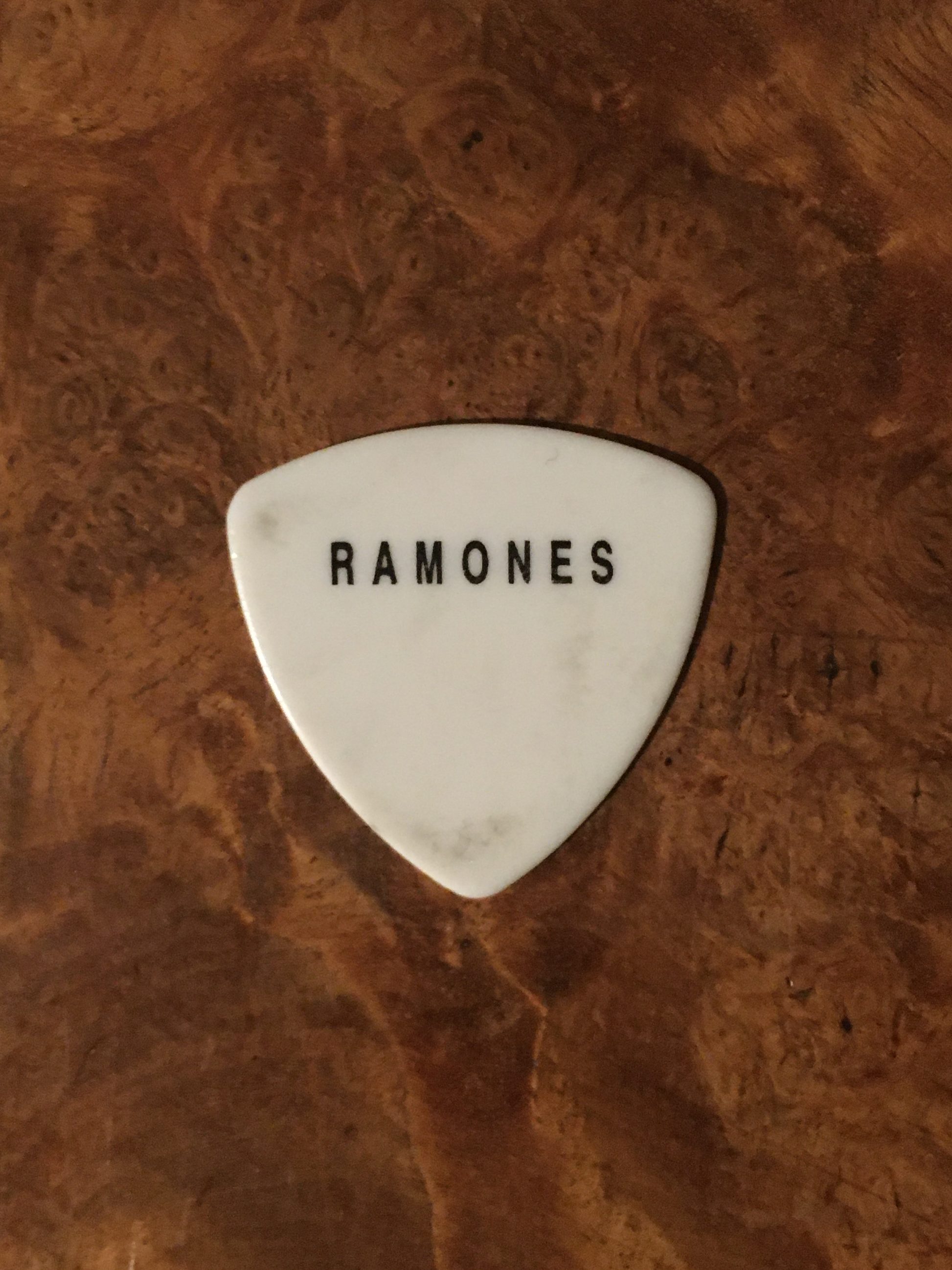
And it was all of these groups that I thought of last month when Daniel and Nick got me two bunches of daffodils – the early ones, shipped in from foreign shores and still unbloomed. I got down two ceramic bowls that Sean Mathews gave me at the end of my senior year at Pitzer, bowls he asked me to take care of because I had brought him to a Diesel show at the Paramour and which I have treasured for 22 years, and which really only make their appearance in daffodil season, when there is a reason to use them. I always keep three ikebana frogs in the bottom, one of which I got at the tea shop, the other two from thrift stores. I showed Daniel how to cut the daffodil stems down so the flowers make three layers, for the heavens, humans, and earth, then to poke them into the spikes on the frogs so they stay upright. I was about to fill the bowls with water when I saw something that looked out of place at the bottom of one of the bowls. It was a white triangular plastic guitar pick, with the word “RAMONES” in black, and it made me think of 1995, when my parents somehow, someway gave me permission to go to a Ramones concert at SOMA. I met up with Kassia, and probably Agata and Jarmilka, and maybe Ananda; I think the Circle Jerks opened for them, and all of my girls wondered how I knew the words to “Wonderful,” although that may have been a different concert. We were typical teenagers, running in and out of the crowd, screaming, hugging each other when we collided, probably being cursed by the older punks who both remembered when the Ramones were on the cutting edge and, probably, when they themselves were teenagers, not 40-somethings whose joints were just starting to break down, who had mortgage payments to make, who would have problems waking up the next morning. I remember stopping toward the side of the pit and thinking how I would, one day, look back on that night and be able to say that I was close enough to Joey to see the sweat on his sunglasses and to wonder how his stick-thin frame could hold up the Gabba Gabba Hey sign, shaking it strongly and forcefully over the crowd like it was a censer.
I doubt I got the guitar pick when it was thrown out by the band – more likely, I bought it at the merch stand. I have no idea how it ended up in the bowl, next to the frogs. But when I saw it lying there, I picked it up, and remembered Brian Wilcox, and everything that he did for me in English class that morning.
 Andrew Samtoy
You have a precious gift, I’ve noticed, that this posting illustrates. You pluck memories from your considerable store, hold them up for your examination and our pleasure, and string them together as a sort of art form. I always come away elated and a little inspired. Thanks—please keep it up!
LikeLike