1. Eat
Tourists will often go to Paris and go to Poilane to get bread; they will get a quarter-loaf, or half, and bring it back to their AirBNB or hotel room and think to themselves, “that’s good bread.” They will instagram it, perhaps, and then maybe actually eat it, and that will be the entirety of their experience.
Maybe this also strikes you as odd, but you never could put your finger on it until Bologna, where you met some of your friends, Charlie and Charlotte, for a week. At the end of their stay, Charlie casually mentions that he had found a good restaurant that he liked, so he just kept going back to it. Bologna is known for its food, so many people would think it was foolish to go to a single, non-famous bistrot for dinner every night rather than try a bunch of different places, hoping to discover the best…something.
Charlie’s approach to dinner may strike you, too, as more more fulfilling, and might mirror your approach to pastries: go to a single place, go there every day of your trip, and, when you leave, have the people know you so that, when you thank them, they will shake your hand and welcome you back any time. If you are in Bologna, your shop of choice may be Patisserie Santo Stefano; if it is, you could easily do worse. Someone said that they had been around since before Columbus sailed; this is unconfirmed, but they certainly had the best cornettos con crema that you have tried in five weeks in Italy. But more than that, becoming a regular allows the workers to get to know you, and lets you meet the workers. At Santo Stefano, there are always two constants behind the counter, a guy, about 50, with a shaved head, and a younger guy, who looked like a handsome Mr. Bean. The older guy always looked severe, as if he was judging you and was not impressed, but this turns out to be just a mask over a joking, friendly interior; after a few days, he may start smiling at you and saying “ciao” as soon as you walk in, and he might also always listen to your sons with the same care, and amused smile, as an indulgent grandfather would when the children point at what they want. The younger guy is more outwardly warm; after four days, if you accidentally don’t order a coffee with the pastries, he will look at you with a furrowed brow, said “e caffe?” in confusion, and, when you say “si,” smile as if the world was back to normal again. On your last day, if you tell him you are leaving, he will give your kids chocolate cookies and shake your hand.
And this is how to truly eat well in Bologna: find one thing that you really like, in one place, and get it daily, for the length of your visit, to the point that they know your order when you walk in the door.

2. Do
In planning for a long trip, you may look up races in all of the places you are going to visit, and you may find a half-marathon in Lucca. This, of course, requires training, so, many mornings, you will have to wake up around six a.m. to go on a run.
Bologna is particularly suited for training at six a.m. Just outside the old southern city walls is Giardina Margherita, which, on clear days, is an excellent place to train; there are many paved loops to run with elevation changes, water fountains and ponds, and, generally friendly runners, although there are two assholes who run clockwise around the lower loop; everyone seemed to try to avoid them. With the other runners, a wave and a “ciao” will get you the same in return; the second time you see them, they will clap; the third, they will say “bravo”; the fourth, a longer Italian phrase that you don’t understand but you will answer with a laugh.
Bologna is also famous for its porticos, or covered walkways, and on rainy days, these are a godsend for anyone who wants to train and stay dry, particularly if you didn’t pack a running jacket because you thought it would be warm, which, in April, it is not. You can go 24 miles within city limits without running through the same porticos twice, hitting rain only when crossing the small streets, and, if you are up early enough, the only pedestrian traffic is street cleaners, grocery stockers, and barmen putting out tables. If you are out past seven, though, avoid Via Castigilone, as the high school students pack the walkways and cafes; while they are generally polite to you, they seem to smell up the air with a million different flowers – I don’t think I have ever run into a group of young people who have such diverse, expensive-smelling perfumes and colognes, and, if you are breathing hard, it can be a bit overwhelming.
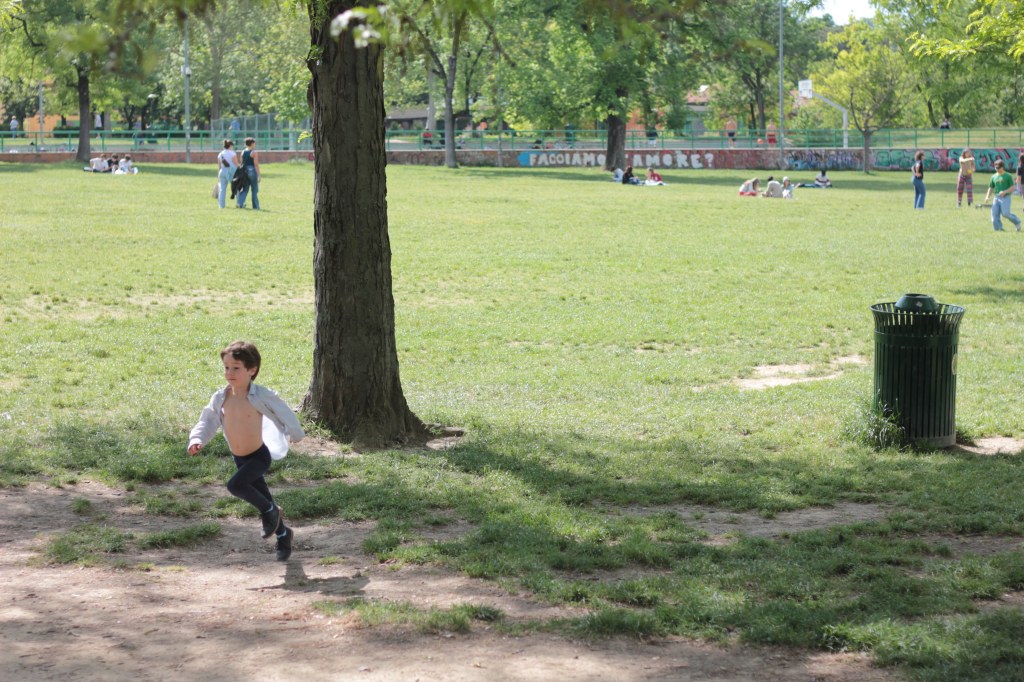
What both of these things give you is an excuse to get out early, a way to see the city without it being packed with people, and an entirely different view of how a city works. You will see the street cleaners – all, it seems, immigrants – and the early-morning cafe workers, the parents dragging kids to school, cars stopping in the middle of a busy street to let shop workers out, lights in pizzarias flashing, trash trucks picking up loads of rubbish, seagulls picking apart sandwiches, espressos being pulled, deliveries being made, suns rising. You will smell earth, compost, bird shit, pastries, fresh rain, the perfume shop that sprays its door with scents to fill the street, beer, cooking garlic, fresh flowers, smoldering candles, disinfectant. You will hear trucks backing up, scooters gunning, glass recycling being emptied, brooms swishing, fish ice crunching, heels clicking, order shouting, bus wheels on cobblestones, hoses spraying, “ciaos” and “ciaos.”
You will touch history, and you will feel alive.
So for the best thing in Bologna to do: run it, either avoiding the assholes on the lower loop and smiling at the others, or dodging around delivery trucks and last-night’s trash past the shops closed with their displays either darkened or removed, on walkways nearly purely of marble.
Because this is your life.
3. Buy
Growing up, there were always ants in El Cajon. In our house, they were constantly outside – burrowing small holes into the dirt, creating long, meandering lines from the plant pot to the fence, pulling dead bees or flies or crumbs along the ground, occasionally appearing overnight in some new gap in a window frame above our kitchen sink. I don’t remember a single time when we didn’t have a looming ant problem in some way.
Generally, it was tolerable. Sometimes, my parents would put out poison, but they didn’t seem to like that option – maybe we wanted to live in harmony with nature, or in as much harmony as a family of four in a green suburb that should have been a brown desert could be. Poison seemed to break that connection with nature.
But then one day, in seventh grade, I found an article in a scouting magazine about a simple, natural ant poison that any young, enterprising American boy could make. It involved making a solution of sugar and water, then soaking chewing tobacco in the solution for at least twenty minutes, then placing the tobacco leaves in the line of ants. The ants would pick up the pieces of chewing tobacco because of the sugar, bring it back to their nest, and then eat it; the toxins in the tobacco would then kill any ant that consumed it. I explained the process to my mom, who then went to Price Club, now Costco, and got a jumbo box of Red Man Chewing Tobacco with maybe ten or twelve pouches in it. She gave them all to me, trusting I was too smart to ever chew tobacco, which turned out to be true – it wasn’t until I was maybe 32 that I tried a lipper at a party, and that experiment lasted all of 12 seconds. But with this trove of Red Man, I immediately followed the recipe, placing small piles of tobacco anywhere I saw a line of ants, then watching to see if the pile got smaller and the ants disappeared, which they seemed to do.
But the amount of tobacco required for killing ants was small, and my supply was very large. What should a young, enterprising American boy do with the leftovers? I began bringing pouches to Greenfield Junior High School and distributing it to my friends – Ted Nelson, in particular, seemed to enjoy it, and probably Brian Wilcox, and a few other guys. It is only now that I realize that they probably hated it, but they wanted to seem mature and cool, so they probably paid me for the privilege, then tossed it as quickly as possible. I may have given it away, but I would bet that I sold it to them, pocketing the cash. Among these friends, I think I got a reputation as someone who liked tobacco, and all that went along with it.
It was because of this reputation, I suspect, that, one day in eighth grade, Randy James came up to me on the playground. He was always a big kid, gentle, friendly, with a goofy smile and an inherent calmness about him. He wanted to talk to me. He had been at his grandmother’s house, he said, and she had had a Zippo lighter in a drawer, and, in his opinion, she didn’t need it, so he had taken it. However, he either didn’t want it or couldn’t keep it; in my memory, his mother would have killed him if she’d found him with his grandmother’s stolen lighter. Returning it secretly was somehow not an option, so did I want it?

I was generally a good kid, so nobody suspected me of much bad. I spirited the contraband home after school and tried to light it, flicking the wheel over and over again. It would not light; it was, I think, brand new, with a bright white wick flecked with red, and a fresh flint, so while it sparked, it didn’t catch. I knew nothing about the internal mechanism, so I decided to try to take it apart – the first of many, many times I would take Zippos apart over the years, the last being in the Berlin airport, removing the flint so I could take it on the plane. But back then, I discovered for the first time that the internal lighter housing slid out of the case, and then that the flint holder could be unscrewed. I pulled out the felt, the padding, and then the wick, but this didn’t help me light it.
It was about this point that my dad came into the living room and saw that I was doing something near the fireplace. I am now thinking that I never gave him enough credit growing up; he asked what I was doing, and I told him that I was trying to get this lighter to work. He sat down with me, looked the pieces over, and told me that it all worked, but that it needed fluid, which I didn’t have. He suggested that we go to the 7-Eleven at the corner of Greenfield and East Main to get some of this magic fluid, and that he would show me how to use it. He kept his word, and, the next day, I filled my first Zippo for the first time, spun the wheel, and then killed its flame by clicking closed the lid.
It was love. I kept that lighter; my parents started getting me Zippos for birthdays and Christmas. At some point, maybe in college, and years before the “everyday carry” fad, I decided that, to the extent it was legal, I would have a pen, a lighter, and a knife on me at all times, because this combination seemed to me to be a good way to be prepared for virtually anything I might need to do in life. Living in the UK, a knife is no longer legally possible, but I can usually either light a stranger’s cigarette or write down a note wherever I go, and I still have a collection of lighters I collected over the years, the last being a plain chrome one that I got for £5 at a thrift store, which, because it had little preexisting sentiment associated with it, I brought on this trip.
The Italians seem to smoke a lot, and opportunities to light cigarettes abound. Leaving Edinburgh for this trip, I filled my Zippo a few minutes before we left; the fluid lasted two weeks, until we got to Bologna, when I had to get a familiar black can of Zippo lighter fluid, which is about five euros, and will, I think, prove to be a critical part of our trip here.
So: coming to Bologna, bring a Zippo, and buy a can of lighter fluid. You won’t regret it.
 Andrew Samtoy
Lovely. You’re in Emilia Romagna, enjoying daily life with your family, making friends, and reminiscing about your first Zippo. 👌
LikeLiked by 1 person