
As a teenager, I bought most of my clothes at thrift stores. I don’t actually know why – at the beginning, it was probably that my parents never gave us much money for clothes, and then I started hanging out with Unitarian Universalists and skaters and punks and I wanted to fit in, so I wanted clothes that were different than those sold at the mall. At the time, thrift stores in San Diego benefitted from a strange convergence of factors: enough wealthy people threw stuff away so that stores had extremely expensive outcasts; the business atmosphere was casual enough, and the weather was warm enough, that any transplants immediately got rid of their silk and wool in favor of denim and cotton; and thrift-store shoppers were generally not fashion-conscious enough to pay attention to major international brands – they wanted to look Californian, or to have functional clothes. It was possible to get, say, Christian Dior ties for $.99 or cashmere Zegna sweaters for $1.49, but Carhartt jeans might be $4.99, a Quiksilver button-up shirt might be $7, and a real Chargers jersey could cost $10. In my drive to be different and simultaneously fit in, I ended up with a wardrobe full of vintage, pastel Lacoste polo shirts, pinstriped Ralph Lauren suits, and my favorite: a blue polyester US Postal Service Shirt that I wore at least once a week and for school photos.
When I went to Pitzer, my shopping habits continued, with a twist: because the most prominent fashionistas at Pitzer dressed in JNCOs or earth-colored hemp sacks, I tended to sport the khaki-and-buttonup look that would have let me blend in with the Young Republicans. Bianca once told me that she thought I was a completely spoiled prep-school kid when we met because I was wearing Ralph Lauren and cargo shorts, and only later did she realize it was a costume that allowed me to move in different circles more easily, and that I was “way fucking weirder than everyone else.” Coming from her, that was one of the handful of compliments I have always cherished.
After college, maybe in 2003 or 2004, I was living in Pacific Beach, on the bay, working for a law firm, drinking with Sonny, trying to find myself. Inland, fires suddenly threatened San Diego and Riverside. I don’t remember such all-consuming fires in my youth, and having plumes of smoke wafting over the beachfront communities seemed apocalyptic. My parents, sister, her fiance, his mother and brother, all of their dogs, turtles, and a newt all came to stay with me in my two-bedroom apartment while they waited to hear whether their homes burned. At some point, frustrated and bored, I picked out one of the Lacoste shirts I had bought for a dollar, then wore at least once a week for a few years, and I posted it on eBay to see what its market value was. After a week, it sold for something like $30. I thought: of course, this is one of the rules of the world – all I have to do is use something a lot and it will increase in value.
And I immediately started selling everything I could.
I went to eBay university with my sister to learn how to best set up my auctions and maximize my profit. I scoured thrift stores at every lunch break and over long Saturday sessions, posting week-long auctions on Sundays, when bidders had more time to fight amongst themselves. I became friends with Beverly, who ran the checkouts at the El Cajon Amvets, and from whom I bought a copper Zippo for $3 that I still use to this day, and who always made sure I got 50% off on at least some of the things I bought when I went to her till. I developed a two-handed technique for rapidly flipping through the racks to look at labels, because I had quickly learned that for used clothes, the brand, not the look, was what really mattered. I learned that people search for designer names, and if it had the right name stitched inside, someone would want it in that size. I did regular research to produce a spreadsheet of the brands of used clothes that sold for over $20; by knowing the minimum price I could get, I could gauge what I should pay for things. I developed a gut-level sense of what was good and what was not so that, if I felt cloth that seemed particularly luxurious but I didn’t recognize the brand, I could buy it, with a good chance that it was something that I had missed but the market would embrace. When I went out, I sized people up by the resale value of what they were wearing – and I had more respect for people who wore things that I knew would retain value in the marketplace.
There were also things that I didn’t understand. Tommy Bahama shirts, for example, were desired by a certain portion of the population; I could get them for a dollar and sell them for $40, easily. Seven7 jeans – the low-rise ones that, combined with a thong, led to the classic 2004 Whale Tails – were also popular with women; I could buy them for $4 and sell them for $80. Vintage Levi’s inhabited a universe too esoteric for me to fully devote myself to, but if I had developed an eye for them, I’m sure I could have made a fortune. At one point, I considered quitting my day job and flipping clothes full-time; however, my job was mostly automated, and I could use all of the filing cabinets behind my desk to store clothes and packing supplies, and I could go to the post office on my lunch breaks if necessary, so I stayed. Eventually, when I decided to go to Spain for a year, I used my eBay profits to put thousands in a bank account to help me settle into Barcelona and develop a student base.
And it continues. I still love a bargain, and I love an arbitrage opportunity; it reminds me of the Kiyosaki exhortation to make, not earn, money. Also, thrift stores and flea markets seem, to me, to be a excellent reflection of a particular society. They show what people valued enough to buy in the past, what they have discarded recently, and what other people value, and for how much.
Here, in the UK, I particularly like flea markets (or “car boots”). The sellers at a flea market vary – some are just doing it for a day to clear out their homes, some attend every week, buying from storage facilities and selling whatever they can. Flea markets also allow for bargains to be obtained if there is a knowledge gap. The thrift store workers in San Diego may have known Louis Vuitton, for example, but they may not have known about Hermes; they may have known Gucci, but not Brunello Cucinelli. Here, in the UK, I have found that the sellers generally know about Le Creuset, but they don’t know that many chefs prefer Staub, or that Julia Child preferred FE (Belgium) to Le Creuset, her official sponsor.
And what if the society does not support thrift stores or flea markets?
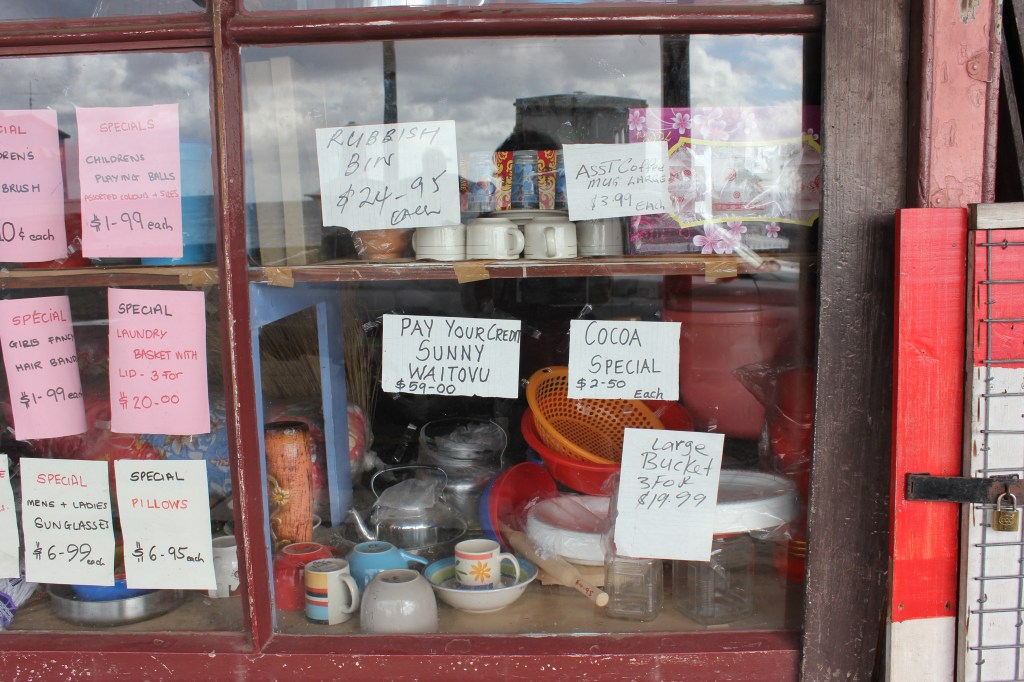

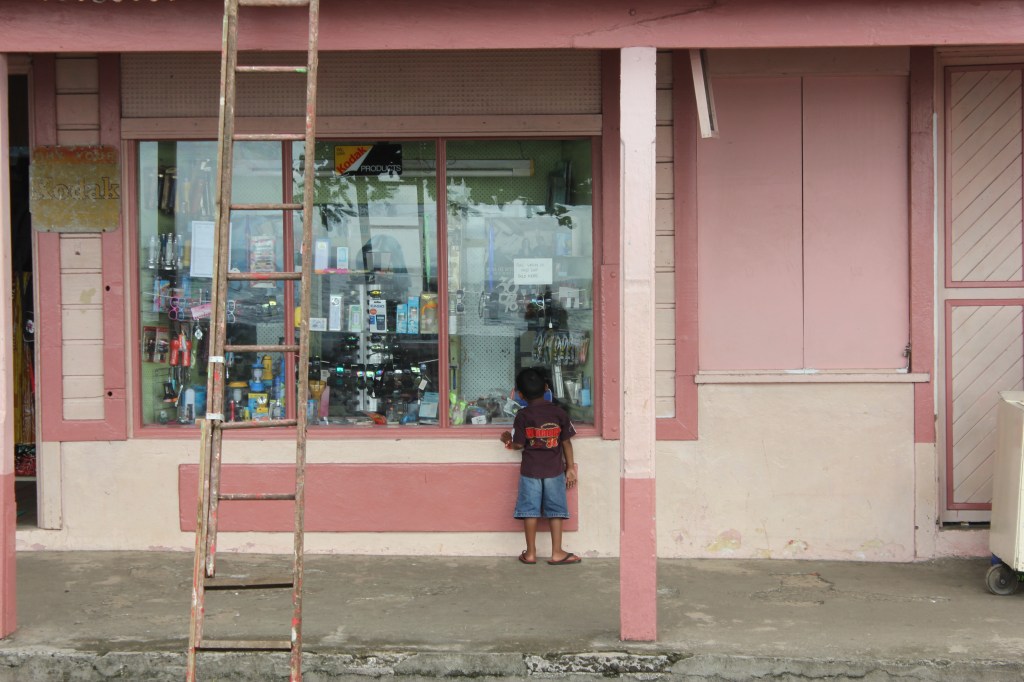
When we got to Levuka, in Fiji, there were a few things that stood out about it. First: drifting toward Levuka on a bus, the smell of fish from the processing plant hits you deep in your sinuses, and you only stop noticing it after a few days. Second, the storefronts all have clapboard fronts that make them look like they were deposited straight from a wild west filmset, and, at night, the streets are poorly lit, so it feels just like an Arizona frontier town may have felt in 1876. And finally: there is a thrift store. This was surprising because, in six months in India, Vietnam, Cambodia, Laos, Thailand, Indonesia, Malaysia, and Singapore, we hadn’t seen a single thrift store anywhere. When I realized that it was the first one we had seen in months, I tried to come up with the reasons that there would not have been one in Hanoi, or Kochi, or Phuket. Maybe people used everything up, or there was a strong cultural sentiment againtst having other peoples’ used things. Perhaps people weren’t wealthy enough to buy things that could have resale value in the first place, so they didn’t have resellable things to discard – or maybe the things people needed to live were generally so cheap, and so readily available from China, that there was no reason to resell things even cheaper. Whatever the market reasons, I think I went to that thrift store in Levuka four or five times, leaving it with a Vietnamese coffee maker and a plain black t-shirt and a “DY-NO-MITE” glassware mug, all of which I still have and use.
When going to Italy, I was eager to get to the local markets, just in hopes of getting some amazing deals. I had read Naples ’44 by Norman Lewis, and ignorantly assumed that there would still be a strong resale trade – I expected that in a country known for beauty, as well as some amount of poverty, the second-hand market would be excellent. I also had a list of vague souvenirs that I wanted: tote bags for shopping, some new article of clothing, and an item I could use for cooking. Souvenirs, in my opinion, need to not be “souvenirs” as people normally understand them; I try to avoid anything that serves merely to remind me that I went somewhere, or to show my travels off to other people. Thus, a “Sorrento Italy” baseball hat, or a “ROME” t-shirt, or a snow globe with the Leaning Tower of Pisa, or a “Outer Banks” bumper sticker, should be left on the shelf. Instead, souvenirs should fit seamlessly into one’s life, should be useful independent of their associations to a particular place, and should not scream merely that the owner, at one point, had enough money and time to travel.
For example, one of the best things I have found to bring back is soap – and not expensive artisan hand-milled soap, but cheap soap, soap that comes from a corner market that caters to people who live in a 200-meter radius, if possible. In Paris, in 2012, I brought back enough euro-a-bar soap to last me three years; every time I showered, I was reminded of the ride from the airport where, in my exhausted state, I was proficient enough to have an hour-long conversation with the cab driver and found out that we were both half-Chinese, and that our Chinese fathers were both Cantonese, and that they were not only Cantonese but were from small villages near Shenzhen, and that they had both grown up on islands in the Indian Ocean (Seychelles and Mauritius), and that they had both made it to France to study, and, at some point, he turned the meter of his taxi off and charged me almost nothing for the ride, and when I finally got out, after ten minutes idling in front of the AirBNB, and I shook his hand, I couldn’t understand why anyone would call Parisians unfriendly. I remembered chilled nights wandering back alleys, red wine catching candlelight, the carriage house AirBNB, the bartender who had lived in Minnesota and gave me a free drink just for telling him I had oublied all of my high-school French classes, tartare and chips in a bistro where the kitchen was smaller than my bathtub, picking up an olivewood lemon reamer that I used earlier today. When I used the mango or peach soap from Mauritius, in 2014, I remembered wandering Port Louis with my dad, watching him navigate streets he had only seen a handful of times in the last forty years to find the library where he had first studied yoga, hearing him order food in pidgin French, code switching from his Montpellier French with an ease that only now strikes me as impressive now that I have to say “courgette” and “aubergine” and “loo roll.” I remember going to the Muslim tailor to get fitted for the two suits which I still wear, getting drunk on champagne and swimming from the boat to the shore above a thousand different kinds of fish, and accidentally finding out that my grandmother had owned a slave.
And in thinking of all of these associations, I don’t know why I have a deep-seated aversion to a souvenir baseball hat or t-shirt that says “Orlando, Florida.” Clothes serve a necessary purpose, and, I’m sure, these items serve to remind the wearers that they once went to Disneyworld. Maybe it’s the ostentation I object to, the feeling that these souvenirs are outward-focused rather than inward-focused, that they brag rather than remind. I need to think about that more.
Anyways, Italy.
Milan’s market, stretched along one of the canals, was absolutely terrible. It consisted of stall after stall filled with Satya Sai Baba Nag Champa incense, track suits, off-brand phone chargers, and things you would expect to buy at a mediocre and independent dollar store. I was shocked at the poor quality of the items. I went to a few thrift stores, but, for the most part, they were all actually vintage stores, with prices to match – nothing like AMVETS or the Salvation Army. It was possible to get nice second-hand things, but at prices that probably reflected their true market value.
So throughout Milan, Florence, and Pisa, I didn’t go hunting for bargains. But in Rome, I read that there was a Sunday market that stretched along the Tiber in Trastavere.
So early in the morning we got off the bus, then walked to the entrance. It was huge, and, for a family with small children and who were hyper-aware of the threat of pickpockets, petrifying. The first stretch of the market was mostly like Milan’s market, but bigger and more crowded, and I was about to write the whole thing off when, at a €5 bag stand, I saw something that reminded me vaguely of Cleveland.
“Wait a second,” I said to Alice, and wandered down the tight aisle between tables heaped with merchandise.
On top of the pile was a small white backpack, obviously hand-sewn, with red, blue, and yellow stripes at odd angles, and a flap on top secured by a small silver clasp. I reached out and felt it, and thought of Michael Hudecek and Forest City Portage. The bag was brand new and, I knew, would retail for at least €120; I knew that because I had looked up Italian sailcloth bags before we had left, and thought that if I could, I would like to get one. I made eye contact with the proprietor, held up the bag with my left hand, and stretched out my right toward him, and he took my €5 and nodded at me.
And, with that, the market suddenly became fun. We got €1 stuffed animals for the boys – a dinosaur for Nick and a Nemo for Daniel – and replacement batteries for our Airtags, and sorted through a pile of antique tools. We got coffee in a cafe to dodge the rain for a bit, then looked at cameras, rocks, plants, toy trucks, polished rocks.
Then, at one stand, I saw a couple of small cardboard boxes that looked familiar. I slid the top off of one and pulled at the steel tang that poked out. It was a straight razor – tarnished but not rusted, with an even blade that would hold an edge, “MARCONI Solingen” stamped on its side. The other one had a big chip that would make it dangerous to use, but I could sharpen and use the first one. The man wanted €30 for both, €20 for one, but just nodded when I offered €15 for the one. As soon as we got back to our apartment, I covered it in WD-40 and let it soak, cleaned it, then sprayed it again to preserve it; as soon as we got back to Edinburgh, I sharpened it, and it gives the best shave of any razor I own.
We went down to Sorrento, which was basically a tourist trap, and then to Palermo. Maybe the north of Italy just has bad markets; in Palermo, wrapping around Giardino Garibaldi, there is a Sunday market that can be truly excellent. The sellers are all there every week; there are vintage stands, a record man, a guy who makes sculptures using auto parts and odd bits of metal, book sellers, and counterfeit watch men. From one guy, who had a lot of vintage ballpoint pens, I bought two bottle openers; the one I kept was from a San Pelligrino soda that was only made between 1950 and 1960, and which now sits in our kitchen, always ready to use (€5). The other was apparently from a Palermo beverage company that, according to the government, is still in existence, but there is virtually no information available on it, which makes me think it might be a front business for the Mafia (€5); I sent that one to my sister, along with a 1930s school dip-pen from a Palermo public school (€5) and several fine-point English nibs that were made in 1929 (a box of 100 for €10). A few weeks later, I found a red shoe horn from a company that listed its address as being around the corner from our apartment (€5); I walked to the address, and, instead of the old Palermo buildings that look like they are in danger of collapsing, there was a new-ish building in its place. I looked back at the writing on the shoe horn and realized that the building had probably been bombed by the allies in World War II, and the shop had been destroyed. Maybe I now use the only remnant still in existence of what were once Antonio Patania’s hopes and dreams.
And a clunky segue: one of the things about Italian AirBNBs is that, generally, the kitchens are incredibly poorly supplied. In Milan, the only thing the hosts gave us to cook with was a strange forked utensil that, on further inspection, turned out to be a cloth-less Swiffer duster; in Florence, we didn’t have knives to cut bananas, much less chicken. It was in Florence that I bought a French Chef knife; in Sorrento, I bought a silicone spatula to cook eggs. So by the time we got to Sicily, I had two cooking utensils that I could use that would always remind me of cutting onions for a sauce for Cassidy, or flipping fresh Sicilian sausage for Nick.
On the penultimate day of our stay in Italy, I went out early in the morning with my camera and a bag. I wanted to take photos of the city before it woke up, and I wanted to collect stray clippings of plants that had fallen on the ground in the hope that I might be able to propagate them back in Edinburgh. I was walking down a street I’d been on a dozen times when I came upon a gigantic, seemingly unofficial, 6 a.m. market, with sellers lined up on the sidewalk and buyers wandering the street. This wasn’t even a flea market; these were poor people, mostly immigrants, just trying to make a few Euros by offloading anything they could get their hands on – old televisions, dirty sneakers, rusted pans, 1980s big-button telephones. I can feel the heightened awareness that grips me when I get to a market – the sense that it was here that a true bargain could be found, and I had the skills to sniff it out. In the Sunday Giardino Garibaldi market, people generally knew the price that they could expect to get for their stuff, and so were in no rush to sell; they could always wait a few weeks and get their asking price. Here, people needed money, and would bargain.
And I found my suppliers: a 30-something couple, a man and a woman, with a giant tarp full of children’s clothes and toys. Sticking out, at the corner closest to me, was the longest rolling pin I had ever seen. I’d been talking with Cassidy about rolling pins, and he’d done surprisingly extensive research; he said that Italian rolling pins were not tapered because they were mostly used for pasta, and they needed more surface area. Because they were used for pasta, they were also wooden, and he explained that other materials – marble, say – would not do as well as wood, since wood gives pasta a rougher surface that is better for holding onto sauce. I’d been wondering if marble might be good, or even a very wide PVC pipe, but, after talking with Cassidy, I knew I needed dead tree.
And the pin sticking out at me was glorious. I picked it up, holding it by the end like it was a sword, weighed it in my hand. The couple looked like they were coming out of a very long argument and were more focused on not looking at each other than paying attention to potential customers; I waved at the woman, and held the pin up. She slowly lifted three fingers. I lifted two, and she just gave a fatigue shrug and nodded. I pulled a two-Euro coin out of my pocket, grazied, and tucked the pin in my plant bag, careful not to crush the philodendron.
So Daniel and Nick: if you wash the rolling pin after making pizzas with them, or water the plants, or see me stropping the Marconi razor, or lighting a candle with the copper Zippo, or use the bottle opener, or get my camera out of the sailcloth bag, or fit a nib into the dip pen for fancy writing and bend the tines, or eat biryani out of the giant FE pot, or lose your shoe horns and can only find mine, this is how we got them.
 Andrew Samtoy
I have vague memories of an Ace Parking shirt button up that you let me borrow for a bit. I don’t think it fit me very well, but I remember wearing it at Music Trader in Poway.
LikeLiked by 1 person
Mein Gott. I’m guessing if you’d had a belly ring it would have shown.
LikeLike
I can never get enough of these memories and I always learn from them. It makes me happy knowing that Nick and Daniel will treasure them.
LikeLiked by 1 person